
See How Modeling and Simulation Is Used Across Industries
Multiphysics modeling and simulation drives innovation across industries and academia — as is evidenced by the many uses showcased in the technical papers and posters presented by engineers, researchers, and scientists at the COMSOL Conference each year.
Draw inspiration from the recent proceedings collected below, or, to find a specific presentation or filter by application area or conference year/location, use the Quick Search tool.
View the COMSOL Conference 2025 Collection
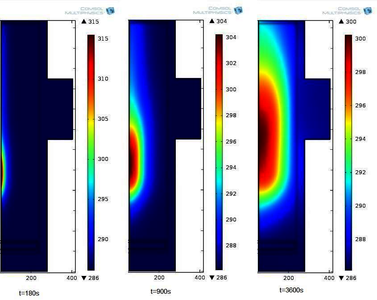
The performance of the oil reservoir is decisively determined by the hydraulic permeability of the rock and the possible flow paths. During the production phase, the petrophysical properties of the rock may deteriorate due to highly viscous oil deposits, especially in the near of the ... Read More

The transition to sustainable production includes the reduction of fossil material usage. Vegetable oil can be used as a reagent to form polyurethane by epoxidation through three major reaction steps, epoxidation, carbonation, and aminolysis. Many attempts have been made to model these ... Read More
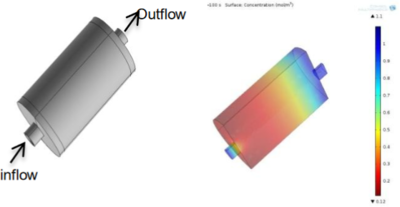
ABSTRACT: Over the years, the most common method of preventing scale formation and blockage of formation pores in oil and gas systems is by squeezing of chemicals into the formation. Different experimental and simulation studies have been carried out to understand the interaction of the ... Read More

OCAS is a joint venture between ArcelorMittal and the Flemish Region. She uses COMSOL Multiphysics for the following: Enamel solidification Magnetic Pulse Forming Electromagnetic modelling of electric machines Vortex Induced Vibrations Model Identification for Orthotropic Materials and ... Read More

Food pastes generally consist of a viscous liquid phase in which a high concentration of solid fillers is embedded and their production often includes a dosing step that involves high speed extrusion. Due to the high volume fraction of solid fillers, this extrusion is not only subject to ... Read More
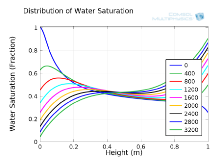
One of the main mechanisms in the secondary oil migration from the source rock into oil traps is gravity driven countercurrent imbibition. Many mathematical models describe countercurrent imbibition considering local equilibrium. However, Barenblatt proposed a model to describe the ... Read More

Differential Acoustic Resonance Spectroscopy (DARS) was developed to examine changes in the resonant frequencies of a cavity perturbed by the introduction of a centimetre-sized sample. This laboratory-based measurement technique fills an experimental gap between the low-frequency stress ... Read More

The solidification of a fluid in a partially-filled circular cylinder is encountered in a number of industrial processes and in the oil and gas sector. The characteristics of the process depends on various fluid and geometrical parameters. In the current study, a fluid with temperature ... Read More
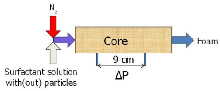
Recovery of oil by gas injection is usually inefficient due to the low viscosity of the gas, which results in bypassing of the oil. By adding surfactant solutions it is possible to get in-situ foam formation. Foam has a much higher “viscosity” and hence does not bypass the oil, leading ... Read More
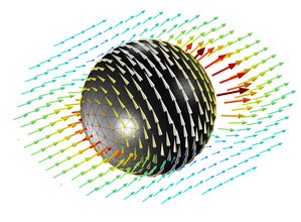
For a specific project in downhole tools for oil and gas wells, we have to weld the tool before shipping and the tool must be programmed during installation on the rig location. For this reason we decided to use magnetic communication and power transmission as well. We have used COMSOL ... Read More


