
Explore the innovative ways multiphysics simulation is being used worldwide to advance research
Multiphysics modeling and simulation drives innovation across industries and academia — as is evidenced by the many uses showcased in the technical papers and posters presented by engineers, researchers, and scientists at the COMSOL Conference each year.
Draw inspiration from the recent proceedings collected below, or, to find a specific presentation or filter by application area or conference year/location, use the Quick Search tool.
View the COMSOL Conference 2026 Collection

The effects of an auxiliary resonating chamber in an in-ear headphone were simulated using COMSOL Multiphysics®. The auxiliary resonator consists of a rubber attachment that can be added to an in-ear loudspeaker. The purpose of the resonator is to increase the low frequency performance ... Read More

In biotechnology and medicine, cells are frequently grown on scaffolds with a three-dimensional channel structure. The oxygen and nutrient supply of the cells is realized by a medium flowing through the channels of the scaffolds. However, it is often difficult to obtain a confluent ... Read More

This abstract describes a COMSOL® App that has been created to perform thermal simulations of an electronics assembly. The assembly comprises fourteen components including a photonic integrated circuit (PIC), a printed circuit board assembly (PCBA), a thermoelectric cooling (TEC) Peltier ... Read More
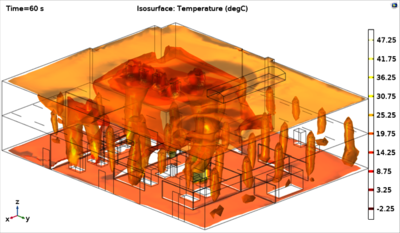
Environmental factors such as temperature and humidity can significantly affect the quality of the metal powder used in power bed fusion additive manufacturing, leading to variations in the integrity of finished components. It is therefore important to monitor and minimize the exposure ... Read More
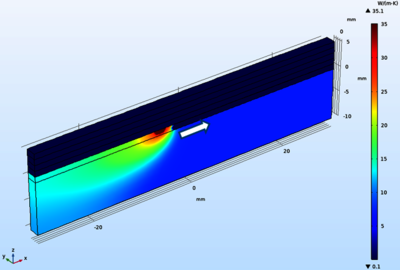
Additive manufacturing processes are increasingly used for designing metallic parts with complex geometries. The current needs are focused on the manufacturing of large-scale parts, typically of meter range. However, for such dimensions, the traditional trial-and-error methodology used ... Read More

In industrial oxygen systems at high temperature and high pressure, contamination by solid particles is one of the principal causes of ignition hazards. Indeed, gas can sweep away particles, generated by corrosion inside the pipes or during maintenance operations (welding residues, ... Read More

Subduction, the process through which the cold and dense oceanic lithosphere sinks into the highly viscous mantle, is the main driving force of plate tectonics and is important for recycling the Earth's materials. Active subduction has not been observed in any other planet in our solar ... Read More

Scraped-surface heat exchangers (SSHEs) handle products that are viscous, that contain particles, and that tend to deposit on the heat transfer surface. The rotating scraper blades continuously remove any deposition on the heating or cooling surface, thereby maintaining the efficiency of ... Read More


