
See How Modeling and Simulation Is Used Across Industries
Multiphysics modeling and simulation drives innovation across industries and academia — as is evidenced by the many uses showcased in the technical papers and posters presented by engineers, researchers, and scientists at the COMSOL Conference each year.
Draw inspiration from the recent proceedings collected below, or, to find a specific presentation or filter by application area or conference year/location, use the Quick Search tool.
View the COMSOL Conference 2025 Collection
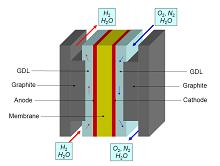
We present computer simulation results for PEM fuel cells using COMSOL Multiphysics® software. We have developed novel PDE equations at NPL from first principles and these are more realistic than models typically used in literature. The theory includes Maxwell-Stephan and Nernst-Planck ... Read More

In this paper an attempt has been made to design and analyze integrated circuit interconnects for unshielded four conductors with three levels system using Finite Element Method (FEM). The computational and simulation work has been carried out with help of COMSOL Multiphysics software. ... Read More

This paper presents an optimized combination of artificial diffusion techniques to stabilize a drift dominated streamer discharge model which includes COMSOL Multiphysics’ Transport of Diluted Species modules for positive ion, negative ion, and electron charge densities, coupled through ... Read More

This paper presents a numerical study of the deposition of submicron charged spherical particles caused by convection, Brownian and turbulent diffusion in a pipe with a smooth wall and with a cartilaginous ring wall structure (see figure). The model is supposed to describe deposition of ... Read More

In this paper it is shown how the equivalent circuit parameters of a MEMS resonator can be simply obtained from an eigenfrequency simulation. Additionally, it is demonstrated that the Q-factor as a result of support losses in a MEMS resonator can be determined using a matched boundary ... Read More

High power Terahertz (THz) sources have become a topic of great interest for a wide variety of applications from medical science to security systems and from material science to telecommunication. The high output power of these THz sources mainly depends upon high current density and ... Read More
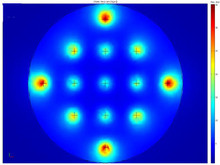
Carbon nanotubes (CNTs) have been proven experimentally to be well suited for field emission applications. An optimized triode configured CNT field emission array is developed using the COMSOL Multiphysics Electrostatics Application to adjust five key physical dimensions to investigate ... Read More
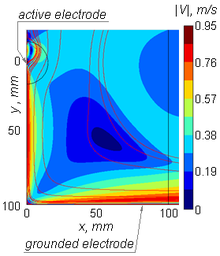
Ionic wind is the gas flow induced by the corona discharge. Ions produced by corona are accelerated by electric field and transfer their momentum to neutral molecules. Using ionic wind one can convert electric energy to kinetic energy of air flow almost directly. The phenomenon of ionic ... Read More

A new design concept for large (6 mm diameter) dynamically focusing silicon membrane mirrors using electrostatic actuation was realized. With this concept membrane buckling by residual compressive stress inside the membrane can be avoided. To eliminate the influence of residual stress ... Read More
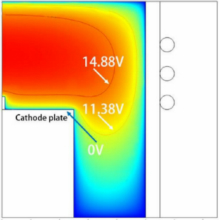
Inductively Coupled Plasma Chemical Vapor Deposition (ICPCVD) has been widely used for carbon-based nanomaterial synthesis because it provides high plasma densities and uniform plasma distribution and allows plasma to be generated in room temperature.[1] During the ICPCVD process, the ... Read More


