
See How Modeling and Simulation Is Used Across Industries
Multiphysics modeling and simulation drives innovation across industries and academia — as is evidenced by the many uses showcased in the technical papers and posters presented by engineers, researchers, and scientists at the COMSOL Conference each year.
Draw inspiration from the recent proceedings collected below, or, to find a specific presentation or filter by application area or conference year/location, use the Quick Search tool.
View the COMSOL Conference 2025 Collection
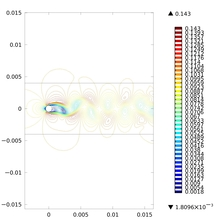
The High Flux Isotope Reactor, located at the Oak Ridge National Laboratory, is scheduled to undergo a conversion of the fuel used and this proposed change requires an extensive analysis of the flow through the reactor core. The core consists of approximately 500 very thin and long fuel ... Read More
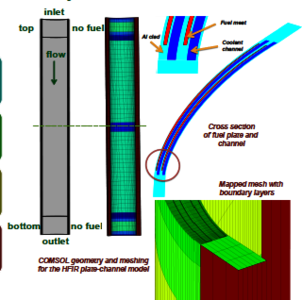
At Oak Ridge National Laboratory (ORNL), COMSOL Multiphysics® software has become a preferred software for certain multiphysics applications in nuclear engineering. This presentation will highlight some of the ongoing activities in the following areas: (1) Highly enriched uranium (HEU) ... Read More

The high temperature measurement of thermal conductivity is vital for predicting nuclear fuel performance both during reactor operation and accident conditions. The proposed method uses experimental thermograms obtained via high temperature laser-flash heating of a disc-shaped sample in ... Read More

The crystal growth industry uses high temperature processes. To improve production efficiency, a good knowledge of thermal effects is necessary. We show in this article a methodology to get reliable data by mixing simplified models, sensitivity studies and parameters adjustments. The ... Read More

Interest in the production of hydrogen from hydrocarbons has grown significantly recently. In order to achieve high surface to volume ratio with reasonable pressure drop, monolithic reactors are used. The goal of this work is to develop a two-phase (gas & solid) transient catalytic ... Read More

Plasma gasification of biomass is emerging as an efficient way to reduce the carbon foot print of waste management while generating renewable energy. In general, gasification is a process where electromagnetic wave energy is used to heat biomass sufficiently to convert the bio-mass to ... Read More
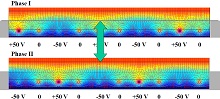
System for in-situ control of the ion angular distribution function (IADF) in plasma reactor is modeled. Typical IADF depends on the pressure, bias and excitation frequency. It is formed due to a difference in the physical properties of the plasma and sheath domains. The IADF is modified ... Read More

In this paper, a 3D dynamic simulation for a portion of a metal hydride-based (LaNi5) hydrogen storage tank is presented. The model is based on heat and mass balances and considers coupled heat and mass transfer resistance through a non-uniform pressure and temperature sorbent bed. The ... Read More

Dehydrogenation of ethylbenzene with a magnetite catalyst has been performed with a fixed bed flow type reactor under microwave irradiation. Microwave heating showed a temperature gradient in the catalyst bed. We analyzed an electromagnetic field and heat transfer in the microwave cavity ... Read More
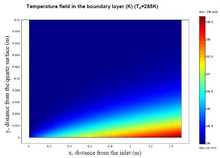
Mineral precipitation on to the quartz surface of the lamp jackets in UV disinfection process (fouling) has been recognized as a major problem for UV radiation delivery during disinfection operation. Fouling behavior was observed to be induced thermally and influenced by hydraulic ... Read More


