
See How Modeling and Simulation Is Used Across Industries
Multiphysics modeling and simulation drives innovation across industries and academia — as is evidenced by the many uses showcased in the technical papers and posters presented by engineers, researchers, and scientists at the COMSOL Conference each year.
Draw inspiration from the recent proceedings collected below, or, to find a specific presentation or filter by application area or conference year/location, use the Quick Search tool.
View the COMSOL Conference 2025 Collection
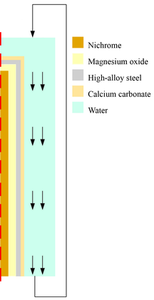
Electric resistances are widely used as heating elements in domestic and industrial equipment; since process water contains calcium carbonate and calcium bicarbonate, limescale plays an important role on global efficiency of water-heating systems. Calcium carbonate has a very low thermal ... Read More

Introduction Self-heating behaviour of dust accumulations is a multiphysics field coupled heat and mass transfer in the porous media. A typical experimental apparatus with a hot storage oven and mesh wire baskets has been taken as the study object. The influence of gas flow velocity, ... Read More
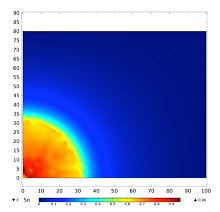
The understanding of the tracer migration in two-phase porous media systems and its reaction over the fluid-fluid interfaces is a challenging task important for a number of engineering applications, e.g. oil recovery, carbon capture and storage in geological reservoirs, remediation ... Read More

In this paper a new method for turbulent combustion modeling is introduced in COMSOL Multiphysics®. The method is called Flamelet Generated Manifolds (FGM). The method is based on the concept of flamelets, elemental reaction layers in combustion. The only hypothesis is that the turbulent ... Read More

Many industrial, especially heterogeneously catalysed, processes are characterised by a strong interaction between the reaction kinetics and transport phenomena. Because experiments in laboratory scale can be very time- and cost-intensive, Temkin and Kul’kova developed a new reactor ... Read More
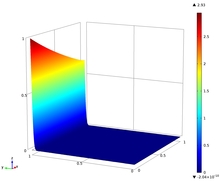
The conventional route to hydrogen production is by steam reforming of methane (MSR) in a multitubular packed bed. With the increasing use of biodiesel as a renewable fuel, interest has grown in steam reforming of the excess glycerol produced as a side product (GSR). We use COMSOL ... Read More
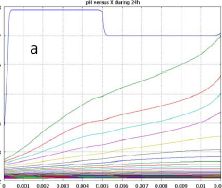
Microbia Fuel Cells (MFC’s) are complex environments where electrochemical, physical and biological aspects must be considered together. In this work we present a 1D model partially describing a Shewanella oneidensis MFC that degrade sodium lactate [lactate -> Acetate + CO2 + 2H+ + 2e-]. ... Read More
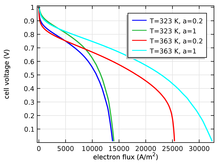
A finite element model of a polymer electrolyte membrane fuel cell (PEMFC) is described in this paper. We divide the PEMFC into two separate and parallel 2D regions which are connected by the 1D regions representing the membrane electrode assembly (MEA). COMSOL Multiphysics® was used as ... Read More
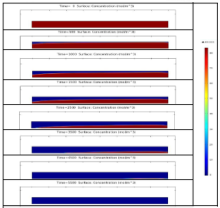
Char combustion is one of the most important reactions in the process of Underground Coal Gasification (UCG). Experiments are performed in a boat reactor under near isothermal condition to demonstrate effects of heat and mass transfer and bed diffusion through ash layer. To obtain a ... Read More
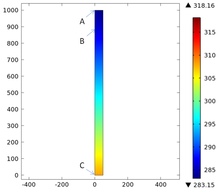
In a carbon sequestration system CO2 would be pumped down a well and into a reservoir at supercritical temperatures and pressures. An important consideration is the long term stability of the reservoir. The goal of these simulations is to thermally model the injection well and ... Read More


