
See How Modeling and Simulation Is Used Across Industries
Multiphysics modeling and simulation drives innovation across industries and academia — as is evidenced by the many uses showcased in the technical papers and posters presented by engineers, researchers, and scientists at the COMSOL Conference each year.
Draw inspiration from the recent proceedings collected below, or, to find a specific presentation or filter by application area or conference year/location, use the Quick Search tool.
View the COMSOL Conference 2025 Collection

Dr. Chin-Hsien Cheng received his PhD. Degree in National Tsing-Hua University, Taiwan in 2007. He joined Institute for Integrated Energy Systems, University of Victoria, Canada as a post-doctoral fellow until Aug. 2009. Currently, he is a research associate and lab manager of the ... Read More

Using modeling software such as COMSOL Multiphysics during the design phase, an approach called “simulation-led design”, allows ideas to be both inspired and validated by the use of simulations. Then, using simulations after the product is designed can shorten the prototype-testing ... Read More

As the light output of the LED is strongly dependent on the thermal performance, thermal interface material (TIM) has become an area of interest that can be used to sink more heat out to the ambient. In COMSOL Multiphysics, physics interfaces like joule heating, heat transfer in solid ... Read More

An experimental LED light composed of a multi-chip LED-module, a LED driver and an efficient heat sink, was investigated using COMSOL Multiphysics software and the Heat Transfer Module. In an LED light heat is mainly generated in the LEDs but some amount of heat is generated also in the ... Read More

The semiconductor and IC package manufacturer are continuously seeking for miniaturization devices to fix into a small space. An unfortunate miniaturization of devices will have an effect on heat dissipation density, which leads to low rate of heat dissipation to the ambient. As a ... Read More

Nuclear fusion represents a promising solution for providing clean and sustainable energy. However, to support fusion reactions, tritium, a rare isotope, must be continuously produced within the reactor. Breeding blankets, which surround the plasma, produce this tritium. These components ... Read More

Thermally conducting but electrically insulating materials are needed for heat-sink LED lighting applications. We report on a cost effective and innovative method based on creating core-shell nanoparticles in polymer with aluminum (Al) nanoparticles as the high thermal conductivity core ... Read More

The release of hydrogen from Liquid Organic Hydrogen Carriers (LOHC) is a highly volume-expanding, multiphase reaction with a high heat demand [1]. Platinum on porous alumina support is used as the catalyst for dehydrogenation. Since reactor design requires a deep understanding of the ... Read More
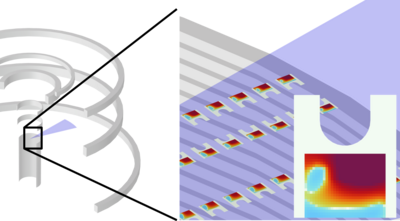
The AC losses that superconducting magnet systems experience during transient events are an important design consideration in fusion reactors. We present results on the approach for calculating AC losses in the high temperature superconducting (HTS) toroidal field (TF) magnets of the ... Read More

The thermo-hydraulically coupled code COMSOL-VIPER (Kröhn and Fromme 2023) based on the balance equations of the experimental VIPER code (Kröhn 2011) for simulating water uptake by bentonite has been further advanced. Bentonite is of particular interest as a geotechnical barrier against ... Read More


