
See How Modeling and Simulation Is Used Across Industries
Multiphysics modeling and simulation drives innovation across industries and academia — as is evidenced by the many uses showcased in the technical papers and posters presented by engineers, researchers, and scientists at the COMSOL Conference each year.
Draw inspiration from the recent proceedings collected below, or, to find a specific presentation or filter by application area or conference year/location, use the Quick Search tool.
View the COMSOL Conference 2025 Collection
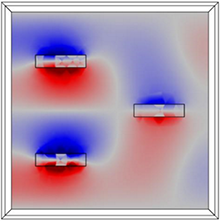
While low frequency light is poorly transmitted through an aperture in a conductive thin film, in the phenomenon known as extraordinary optical transmission (EOT), a narrow band of selected frequencies are transmitted when incident on an array of subwavelength periodic apertures where ... Read More
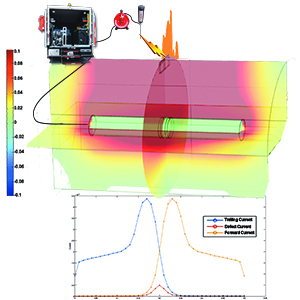
Traditionally, municipal sewer and water agencies have relied on acoustic data loggers and closed-circuit television cameras to inspect pipes for leaks. In addition, the same legacy techniques have been used to certify new and rehabilitated pipes as watertight. Unfortunately, visually ... Read More

Finite element analysis (FEA) is a modern tool for exploration of new horizons in science, technology and engineering. Different computer software such as ANSYS, ABACUS, PZFLEX and COMSOL Multiphysics® based on FEA are used for modeling and simulation of acoustic phenomena, for design of ... Read More
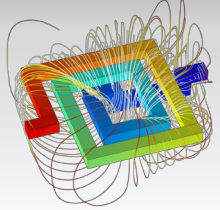
This session addresses some common challenges in electromagnetic modeling and simulation. The introductory presentation will cover how to pick and choose between a large number of available formulations in three separate modules including the AC/DC Module, RF Module, and Wave Optics ... Read More

This paper introduces an efficient model to describe energy dissipation in acoustic. When the propagation domain has hard wall boundary conditions only viscous and thermal losses happen and are completely described by the so-called Full Linearized Navier-Stokes model (FLNS) which is ... Read More

In magnetically confined fusion devices, electron cyclotron resonance heating (80-170 GHz) is characterized by a local RF-power deposition at the electron cyclotron resonance [1]. A mm-wave RF Gaussian beam is launched from a dedicated antenna and propagates through the highly turbulent ... Read More
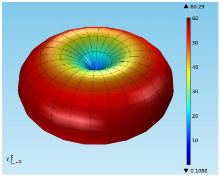
It is demonstrated how the RF Module of COMSOL Multiphysics® can be used to approximately model thin conducting wires or cables and how they interact with a surrounding electromagnetic field. Despite being non-stringent the method can reasonably well predict currents induced by an ... Read More
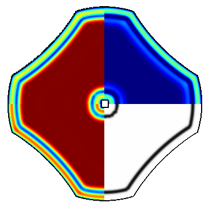
When acoustic applications include small geometries, i.e. mm/submillimeter range, so-called thermoviscous effects can greatly affect the pressure response. This paper deals with acoustic topology optimization of such miniature structures with thermoviscous effects taken into account. ... Read More
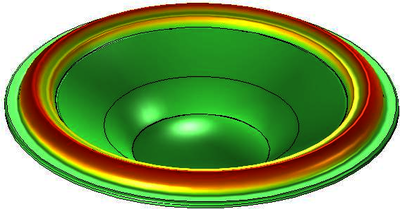
The vibration of an electrodynamic loudspeaker driver causes a resulting sound pressure. For simple pistonic vibration, there is a simple relationship between the vibration and the sound pressure. For complex vibration patterns, however, different parts of the vibrating surface ... Read More

COMSOL analysis of the acoustic modes of two different Combustion Wind Tunnel Facility’s test sections was conducted in this project. The test sections are rectangular ducts, therefore the mathematical expressions to predict the longitudinal and transverse modes inside a tube were used ... Read More


