
Explore the innovative ways multiphysics simulation is being used worldwide to advance research
Multiphysics modeling and simulation drives innovation across industries and academia — as is evidenced by the many uses showcased in the technical papers and posters presented by engineers, researchers, and scientists at the COMSOL Conference each year.
Draw inspiration from the recent proceedings collected below, or, to find a specific presentation or filter by application area or conference year/location, use the Quick Search tool.
View the COMSOL Conference 2026 Collection

Bio-compatibilized G/GO/RGO composite structures with embedded stearic acid on a bilayer structure model, biomimicking the cellular lipid bilayer are introduced through successive models. The solvent accessible surface of the models (van der Waals surface) and the related MD values were ... Read More

Atherosclerosis causes the deposition of plaque on the inner walls of arteries, which leads to restricted blood flow. Using the balloon angioplasty procedure, stents can be inserted and expanded in the atherosclerotic artery. We used COMSOL Multiphysics Structural Mechanics, Solid Stress ... Read More

MEMS sensors exhibit rapid response with minimum sample volume at higher sensitivities. This makes them suitable for detection of Micro/nanoparticles and can also use to monitor their physical process at that scales. Micro-cantilevers based sensing is widely used in the detection of mass ... Read More

The U.S. Naval Academy has used COMSOL as a research tool for many years. Academic usage of COMSOL for student use has only begun in the last five years. Student involvement comes in four types, course-wide usage, focused course related work, student projects and semester-long research ... Read More

Selective Laser Melting (SLM), like many other additive manufacturing techniques, offers flexibility in design expected to become a disruption to the manufacturing industry. The current cost of SLM process does not favor a try-and-error way of research; which gives more room for ... Read More
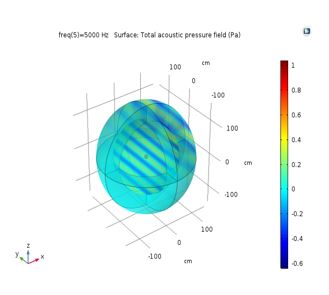
An Acoustic Vector Sensor (AVS) is a compact device used for finding azimuthal as well as elevation angle of an acoustic source using particle velocity and pressure measured at the acoustic center of the device. There are mainly two types of AVS; namely P-P and P-U based AVS. P-P based ... Read More

Electromagnetic (EM) flowmeters are important flow sensing devices across industries like oil and gas and power generation. The EM flowmeter works on the principle of Faraday’s law of electromagnetic induction. In short, when an ionic fluid like water flows through a pipe, in the ... Read More

Laser-based powder bed fusion (LPBF) is a promising additive manufacturing technology, where metallic parts are produced in a layer-wise manner. At each step, a rapid-moving laser irradiates and subsequently melts predefined zones of a relatively thin layer of fine spherical metal ... Read More


