
Explore the innovative ways multiphysics simulation is being used worldwide to advance research
Multiphysics modeling and simulation drives innovation across industries and academia — as is evidenced by the many uses showcased in the technical papers and posters presented by engineers, researchers, and scientists at the COMSOL Conference each year.
Draw inspiration from the recent proceedings collected below, or, to find a specific presentation or filter by application area or conference year/location, use the Quick Search tool.
View the COMSOL Conference 2025 Collection
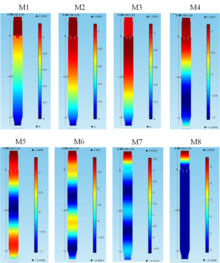
In this work a thermoacoustic analysis of a tubular combustor with an advanced lean injection system is presented. The performed analysis is based on the resolution of the eigenvalue problem related to an inhomogeneous wave equation which includes a source term representing heat release ... Read More
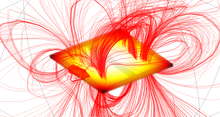
This paper presents the electrical and thermal analysis of an OLED module. The OLED module consists of the OLED tile and the DC-DC converter incorporated in its backplane. The DC-DC converter is realized as an integrated circuit and its inductor is embedded in the the backplane. The DC ... Read More
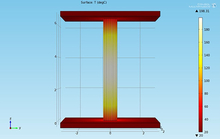
The paper presents recent results concerning the experimental mechanical characterization, the numerical modeling and the design of micro-needles used in the construction of probe heads for wafer testing. A fully coupled electro-thermal model was created using COMSOL and combined to a ... Read More

Drying of porous materials is characterized by the invasion of a gaseous phase replacing the evaporating liquid phase. Vacuum drying is an advanced method applied to oakwood to diminish discoloration, so understand its physics is a very important task. In this work, a two-scale model is ... Read More

Patients undergoing surgery are sensitive to infections. The operation staff may spread 10^4 particles per person per minute, of which ten percent are presumed bacteria-carrying. We visualize the influence of the personnel on the air and particle flows for the two most common ventilation ... Read More

Cochlear Implants are implantable devices which bypasses the non-functional inner ear and directly stimulates the hearing nerve with electric currents thus enabling deaf people to experience sound again. Implant electrode array design is limited in electrode count, due to their large ... Read More

We propose a simplified numerical method to model the flow field downstream of an axial impeller. The method can be used for any axial hydraulic machinery for which, one is less interested by the flow between the blades, than by the flow field downstream of the machinery. The method is ... Read More

The contrast between hydro-mechanical behavior of the rock matrix and fracture network systems results in flow partitioning between fracture and matrix systems which is affected by the In-situ stress regime. Fracture flow, Darcy law and free and porous media flow physics interfaces of ... Read More


