Explore the innovative ways multiphysics simulation is being used worldwide to advance research
Multiphysics modeling and simulation drives innovation across industries and academia — as is evidenced by the many uses showcased in the technical papers and posters presented by engineers, researchers, and scientists at the COMSOL Conference each year.
Draw inspiration from the recent proceedings collected below, or, to find a specific presentation or filter by application area or conference year/location, use the Quick Search tool.
View the COMSOL Conference 2026 Collection
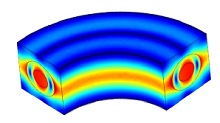
Charged particle accelerators require large dipole fields with stringent homogeneity requirements needed to bend particle beams without defocussing. Commonly superconducting saddle coil magnets are used with an iron core to enhance the bore field. The iron uneven magnetization brings ... Read More

The use of an acoustic field to control the boiling process has the potential to increase the overall rate of heat transfer and delay the critical transition to film boiling. This system is being investigated through the development of a model of a single boiling bubble near a flat, ... Read More

The paper outlines a two-dimensional computational methodology and presents results for laminar/laminar condensing flows inside mm- scale ducts. The methodology has been developed using MATLAB/COMSOL platform and is currently capable of simulating film-wise condensation for steady and ... Read More

Reynolds equation is used to analyze fluid flow through small gaps. As such, the solution of Reynolds equation provides critical information for a wide range of tribological problems. In any case where a lubricant resides between two moving surfaces, the Reynolds equation can be used to ... Read More

The research team has devised and patented an oscillating, hydro-kinetic power-generating device for use in river and tidal environments. The interaction of water and the designed foil in a straight rectangular turbulent channel is modeled explicitly using two conservation laws: ... Read More

Enzymatic biofuel cells (EBFCs) are miniature, implantable power sources, which use enzymes as catalysts to perform redox reaction with biological fuels such as glucose. In this study using COMSOL Multiphysics, we use an EBFC chip, having three dimensional, highly dense micro-electrode ... Read More

The flow channel design on bipolar plates affects proton exchange membrane (PEM) fuel cell performance by influencing reactant distribution and water removal in an operating fuel cell. The fuel cell performance can be improved by varying the type, size, or arrangement of channels. Two ... Read More

Electrochemically-active conducting polymers (ECP) swell or shrink in response to ion and solvent incorporation or ejection as a result of electrochemical reaction of the polymer. When anodic potential is applied to an electrode attached to one end of ECP strip, the oxidation process ... Read More