
Explore the innovative ways multiphysics simulation is being used worldwide to advance research
Multiphysics modeling and simulation drives innovation across industries and academia — as is evidenced by the many uses showcased in the technical papers and posters presented by engineers, researchers, and scientists at the COMSOL Conference each year.
Draw inspiration from the recent proceedings collected below, or, to find a specific presentation or filter by application area or conference year/location, use the Quick Search tool.
View the COMSOL Conference 2026 Collection

After previous microwave simulations done with very hard assumptions, we improve the model by using Funer model to improve prediction of plasma effects on the microwave coupling. Some parameters are still not well known and are used as adaptation parameters. An experience plan technique ... Read More
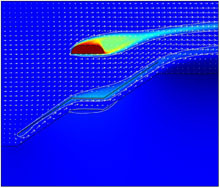
We present COMSOL solutions for a coupled gas flow and heat transfer problem, which occurs particularly when traffic pathways are constructed in high altitude and arctic regions, where the underground is frozen soil. To avoid melting of the frozen ground (which usually leads to ... Read More

A very simplified system for high voltage test is studied, considering reason for voltage holding failures which are not covered by conventional and local design criteria. A first understanding of the problem is obtained by solving the electrostatic potential in a 2D axis symmetric ... Read More

An enhanced method is used for analysis of third-order nonlinearities in optical nanostructures with scalar TM (H-field) frequency domain formulation. After embedding it in COMSOL Multiphysics it is shown to produce fast and accurate results without superfluous vector E-field formalism. ... Read More

The emergence of electromagnetic metamaterials has given rise to a variety of fascinating applications, including the perfect lens and the optical cloaking device. For a long time the study of the properties of metamaterials was limited to normal incidence only. However, it is extremely ... Read More

Scanning electrochemical microscopy (SECM) is a powerful tool recently developed for studying structures and processes in micrometer and submicrometer sized systems. It can probe electron, ion, and molecule transfers, and other reactions at solid-liquid, and liquid-liquid, interfaces . ... Read More

Cooling of high-power density electronic devices remains a challenge. Microfluidic heat-pipes with the potential of achieving ultra-high thermal conductivities offer a low-cost technology for cooling electronics. To achieve high thermal conductivity, it is critical to maximize the rate ... Read More

Cellular ceramic substrates are extensively used for pollution control systems in vehicles. The manufacturing process of them can involve microwave drying. In this study, we describe the development of a modeling framework for the microwave drying process of these substrates. The ... Read More


