
See How Modeling and Simulation Is Used Across Industries
Multiphysics modeling and simulation drives innovation across industries and academia — as is evidenced by the many uses showcased in the technical papers and posters presented by engineers, researchers, and scientists at the COMSOL Conference each year.
Draw inspiration from the recent proceedings collected below, or, to find a specific presentation or filter by application area or conference year/location, use the Quick Search tool.
View the COMSOL Conference 2025 Collection

Assistant Professor Chin-Chuan Hsu received his Master degree (1991) in Materials Science and Engineering from National Cheng Kung University, Tainan, Taiwan. In 1995 he received the Ph.D. degree in Materials Science and Engineering from National Taiwan University, Taipei, Taiwan. From ... Read More

The present study is motivated by the recent concerns raised over the existence of segmental outflow of the aqueous humour (AH) and its implications on ocular drug delivery. A 3D model of the human eye is developed, where hydrodynamic and mass transport analyses, specifically after eye ... Read More
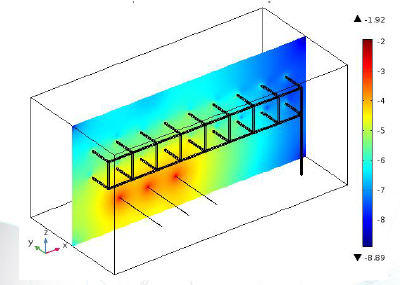
Electromagnetic fields are pervasive in today’s urban environment and under certain circumstances exposure has led to safety hazards that have been reported to cause personal injury. The United States Department of Labor has reported multiple cases of electrical shock on construction ... Read More

An electrochemiluminescence (ECL) sensor was developed in a smartphone-based platform using a disposable disk-shaped carbon electrode. A time-varying square waveform potential was applied to the working electrode, and the current and ECL intensity data were measured. The applied ... Read More

In the field of coding and industrial marking areas, CIJ technology is based on high speed emission of ink drops (20 m/s) which are directed onto a moving printing medium. The printing quality depends, on one hand, on drops position on the media determined by the drop charge and the ... Read More

The use of numerical techniques in PEM fuel cell sensoring represents an advantage of project engineering, reducing the costs and accelerating the manufacturing of prototypes. In this work some numerical responses are shown, relating to numerical sensoring of water and oxygen mole ... Read More
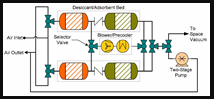
Aboard the International Space Station, carbon dioxide is removed from the atmosphere using a four-bed adsorptive separation process, referred to generally as a 4-Bed Molecular Sieve (4BMS). Experience with the current 4BMS design in space has led to a list of areas for improvement for a ... Read More
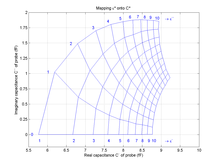
The current drive to go beyond the state of the art in novel near field scanning microwave microscope (NSMM) metrology at the micro scale, to make them capable of traceable measurements on functional materials, has led to the development of a finite element model of the probe of a ... Read More

The measurement and regulation of particulate matter to improve outside air quality advanced a lot over the last decades. This also made it necessary to develop primary standards for calibrating these measurement systems and in future the composition of relevant aerosols will be taken ... Read More
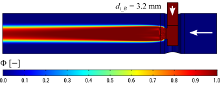
Two-component adhesives are commonly used for sealing and joining in transport applications for mechanically highly stressed connections. At the Chemnitz University of Technology an innovative system technology for the user-friendly, wireless and energy-efficient processing of two ... Read More


