
Lorenzo Bortot, CERN, Switzerland
Engineers and physicists at CERN go to great lengths to ensure that the high-power superconducting magnets that maintain the circular trajectory of particles inside the Large Hadron Collider (LHC) do not revert to a resistive state, an event known as a quench. To understand and prevent quench events, Lorenzo Bortot, an electrical engineer and research fellow at CERN, used numerical simulation to develop a multiphysics, multiscale, and multirate representation of the electrodynamics and thermal evolution of a quench event.
Suggested Stories
Voxelgrids Pioneers Accessible MRI Technology Through Virtual Analysis
Voxelgrids Innovations developed India's first locally made MRI scanner, which was specifically designed to be more ...
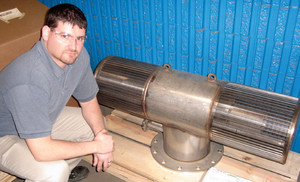
The Science of Water Screening
Johnson Screens® are the manufacturers of steel screens that impede debris from lakes and rivers from entering pipes ...
3D Modeling of Armor Losses in High-Voltage Cables
NKT HV Cables used numerical modeling to investigate electromagnetic fields and calculate armor losses in 3D cable ...
Tiptoeing Through the Tulips to Protect Power Plants
ABB, a multinational leader in electrification products and power grid technology, develops generator circuit ...


