
Lorenzo Bortot, CERN, Switzerland
Engineers and physicists at CERN go to great lengths to ensure that the high-power superconducting magnets that maintain the circular trajectory of particles inside the Large Hadron Collider (LHC) do not revert to a resistive state, an event known as a quench. To understand and prevent quench events, Lorenzo Bortot, an electrical engineer and research fellow at CERN, used numerical simulation to develop a multiphysics, multiscale, and multirate representation of the electrodynamics and thermal evolution of a quench event.
Suggested Stories
Compressing the Timeline to a Fusion Future
General Fusion has successfully designed and optimized a fusion demonstration machine with the help of multiphysics ...
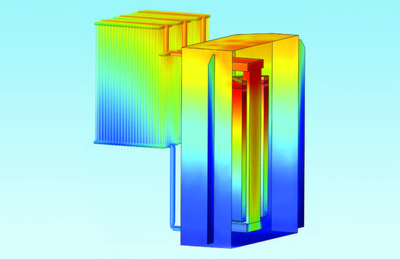
Simulation Enables the Next Generation of Power Transformers and Shunt Reactors
From power generation to its distribution to end users, power transformers and shunt reactors are used throughout the ...
WiTricity Leverages Magnetic Resonance for Flexible Wireless Charging
Engineers at WiTricity have developed a flexible wireless charging setup that relies on magnetic resonance and can be ...
Developing a Novel Battery Model to Answer Classical Chemistry Questions
Researchers at the Flemish Institute for Technical Research (VITO/EnergyVille) and KU Leuven developed a model of a ...


