
J. Morgan, R. Greegor, P. Ackerman, Q. Le
Boeing, WA, USA
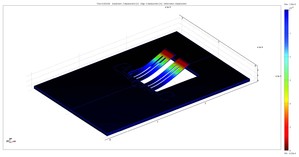
Carbon fiber composites are used extensively throughout the body of modern aircraft, such as the Boeing 787 Dreamliner, because of their exceptional strength and light weight. Expanded metal foil (EMF) is added to the composite structure layup as a protective measure to dissipate the extreme heat and current generated by a lightning strike. Engineers at Boeing Research and Technology (BR&T) are using multiphysics simulation and physical measurements to ensure that protective coatings on the EMF remain intact when subjected to thermal stress arising from the ground-to-air flight cycle. The impact of the EMF design parameters on stress buildup and displacement in each layer of the composite structure layup was evaluated in COMSOL Multiphysics®. Experiments correlated well with simulation results, which confirmed that designs characterized by lower displacements also have a reduced likelihood of crack formation.
Suggested Stories
Keynote: Using COMSOL Multiphysics® for Circuit Board Thermal Analysis
The aerospace and defense industry requires stronger circuit boards than those needed for everyday electronics due to ...
Easy and Accurate Measurement of Blood Viscosity
Microvisk Technologies develops and manufactures devices for measuring blood viscosity using the power of Micro ...
Analyzing the LHC Magnet Quenches
Engineers and physicists at CERN go to great lengths to ensure that the high-power superconducting magnets that ...
A New Route to High Sensitivity Pressure Sensors
The environments in which sensors are most integral are often the most harsh and unforgiving, such as vacuum chambers, ...


