
Harvey Buck, Roche Diagnostics Operations, Inc., Indianapolis, IN, USA
The test strips in glucose monitors, widely used by people with diabetes to maintain good health, are sensitive to chemical interferences and environmental conditions. The manufacturing process and electrode configuration of these strips also affects response accuracy. Researchers at Roche Diagnostics Operations, Inc. used multiphysics simulation to analyze the chemical reactions and voltage response in their glucometers.
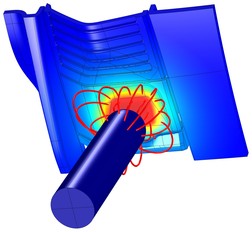
Using COMSOL Multiphysics, Harvey Buck, principal scientist at Roche, investigated different configurations and materials used in the test strips. He analyzed the electrical response to an applied voltage during the chemical reaction catalyzed in a sample. Through numerical simulation, he predicted the sensitivity of electrical impedance measurements to mechanical properties of the sensor. He also optimized the electrode configuration, maximized sensitivity to cell fraction in a sample, and minimized sensitivity to manufacturing tolerances. These simulation results have given the Roche team a better understanding of their integrated sensor design for glucose monitoring.
Suggested Stories
Designing Smart Solutions for Gas Flow Devices with Multiphysics Simulation
As India moves toward a reduced dependence on fossil fuels, researchers at Raychem RPG used multiphysics simulation to ...
Switching Made Easy
Modern cars offer a wide range of complex functionality that comes with several design challenges. This story ...
Man-Made Stars: Evaluating Structural Integrity in High-Performance Nuclear Fusion Machines for Power Generation
For over 50 years, power generation through nuclear fusion has been the focus of international research efforts to ...
Analyzing a Timeless Tradition Found in Ultra-Luxury Watches
Engineers at HEPIA, HES-SO Geneva are fine-tuning luxury-watch minute repeaters with a surrogate-model-led process ...


