
India's National Chemical Laboratory Optimizes Fuel Cells via Modeling
Ashish Lele, National Chemical Laboratory, India
Inefficient and potentially harmful diesel generators are still the prevailing method of decentralized power generation for telecommunications in urban and rural India. Researchers at the National Chemical Laboratory are investigating proton exchange membrane (PEM) fuel cells, which are strong candidates for this industry because of their cleanliness, compatibility, and efficiency exceeding 30% (with work underway to further increase this value). Using multiphysics modeling and simulation, the researchers are working to determine an optimal configuration of fuel cell properties that yields maximum efficiency and performance.
Suggested Stories
Producing Power, Protecting Fish with a Darrieus Water Turbine
Physixfactor used simulation to design a water turbine for use in coastal flood control structures in the Netherlands. ...
Magnetic Transmissions Increase Lifespan of Offshore Wind Farms
Sintex is a developer and manufacturer of magnetic couplings, systems that transmit torque and power with ...

Optimizing Solar Cell Designs with a Simulation App
The SolCelSim app, designed by an MSc student at the University of Zilina, enables researchers to simulate solar cell ...
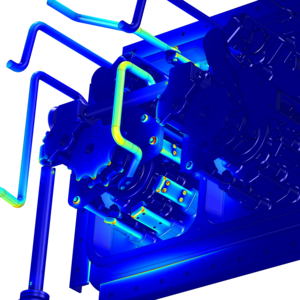
Dielectric Stress Simulation Advances Design of ABB Smart Grid-Ready Tap Changers
Consumers of power rely on fairly stable voltages. Transformers contain tap changers which vary the ratio of secondary ...


