
Xi Engineering and WAT Design Headphone Transducers with Modeling
Brett Marmo, Xi Engineering; Martin Roberts, WAT, UK
Electrostatic transducers offer enhanced clarity, less distortion, and a wider bandwidth than transducers in conventional dynamic-driver headphones, but they are only seen as high-end alternatives. The precise manufacturing requirements make electrostatic transducers prohibitively expensive to produce and hinder mainstream commercial viability. Engineers at Xi Engineering and Warwick Audio Technologies (WAT) developed an easy-to-manufacture electrostatic transducer with multiphysics modeling and simulation apps. Using simulation involving a structural-acoustics-MEMS coupling, engineers were able to capture the highly nonlinear behavior of the high-precision electrostatic laminate (HPEL) transducer used in headphones and optimize its performance.
Suggested Stories
Look Inside the Battery with COMSOL Multiphysics®
The key to designing high-performance, durable, and safe batteries is to first understand the battery technology and ...
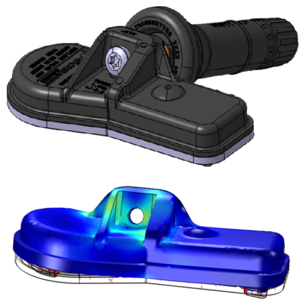
Optimizing Built-in Tire Pressure Monitoring Sensors
Built-in tire pressure sensors need to be able to withstand the wear and tear of working within a car’s tire rim. ...
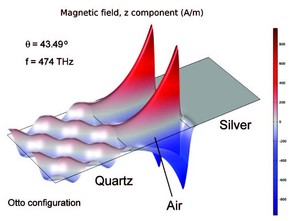
Surface Plasmon Resonance
Surface Plasmon Resonance (SPR) is created by surface plasmons, coherent electron oscillations existing between any ...
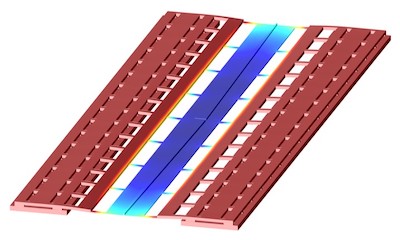
Designing a Silicon Photonic MEMS Phase Shifter with Simulation
Researchers at the Swiss Federal Institute of Technology Lausanne are using simulation to optimize the optical and ...


