
Toyota Improves Electronic Component Cooling with Simulation
Toyota Research Institute of North America, MI, USA
The Toyota Research Institute in Ann Arbor drives cutting-edge research in energy efficiency, mobility infrastructure, and safety. Here, Ercan Dede and his team are designing heat sinks (or cold plates), which are affixed to fragile electrical systems and other applications in Toyota’s hybrid vehicles.
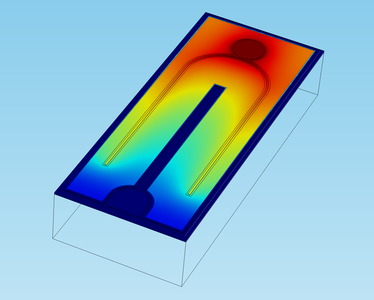
Their simulations simulate the cold plate’s topology for improved cooling efficiency while minimizing pressure drop. Previous designs provided good heat transfer, but at the cost of significant pressure drops across the plate. Making use of branching channels, the heat sinks provide the same heat transfer but with an optimized flow path. Using LiveLinkTM for SolidWorks®, they were able to create fast and accurate design iterations, leading to an optimal cold plate topology.
SolidWorks is a registered trademark of Dassault Systèmes SolidWorks Corp.
Suggested Stories

New Method for Performing Topology Optimization of FSI Problems
Many topology optimization methods are only available for FSI problems within a purely academic scope. Enter the TOBS ...
Multiphysics Software, a Versatile, Cost-Effective R&D Tool at Sharp
There are several kinds of technology that designers at Sharp Laboratories of Europe work to create. From LED ...
Upgrading the Nuts and Bolts of the Electrical Grid for a New Generation
Migrating the electrical grid to a “smart grid” is usually discussed in terms of IT issues or embedded systems. Yet, ...

Reduced-Order Modeling of Ultrasonic Pipe Measurements
A guest blogger from SINTEF demonstrates how they use 2D axisymmetric simplification to reduce computation time for ...


