
Introduction to Battery Modeling
This course provides an introduction to modeling batteries using the COMSOL Multiphysics® software and its add-on Battery Design Module. Through comprehensive discussions and several step-by-step modeling demonstrations, you will learn how to set up, build, and compute simulations for various types of battery applications. You will also learn about best practices, various specialized physics features, and modeling approaches you can use to efficiently model batteries. This includes using using a multiscale approach to balance computational efficiency with accuracy, or using an iterative approach to gradually build up complexity in your battery model.
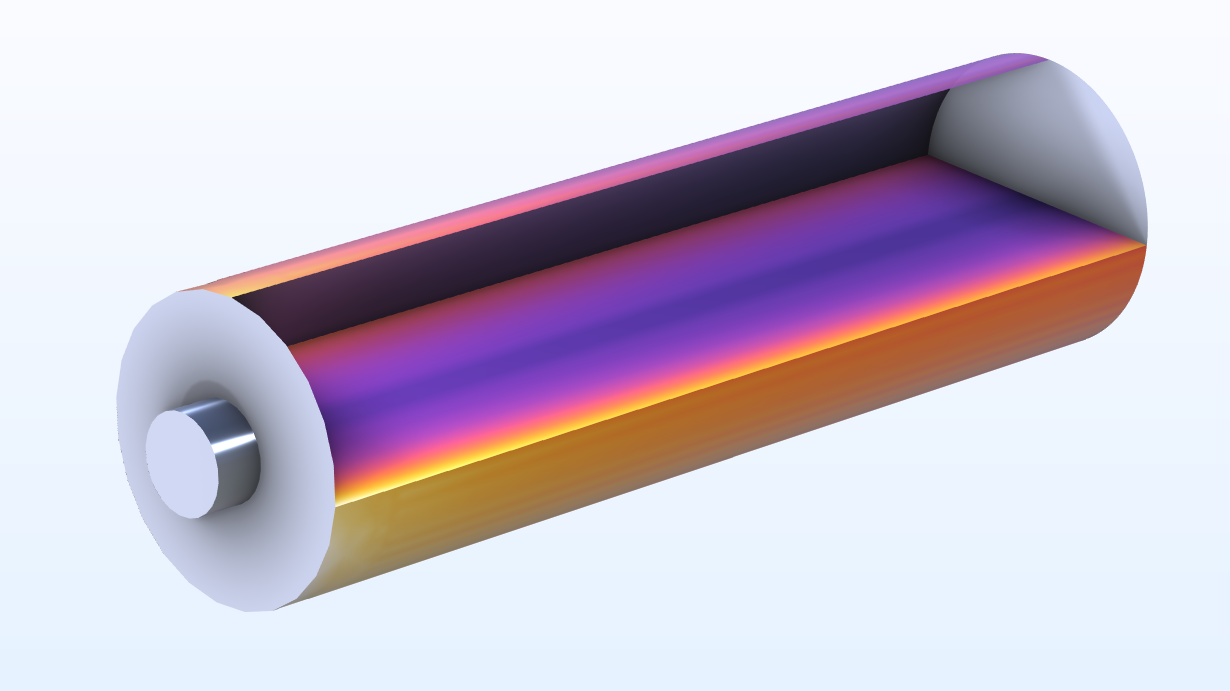
The temperature profile in a cylindrical lithium-ion battery during a charge/discharge cycle, one of many examples discussed and shown in the course.
An overview of the what is covered throughout the course is as follows:
Part 1: Electrochemistry and Battery Modeling Fundamentals
- Introduction to the current distribution interfaces
- Introduction to battery specific interfaces
- Overview of the electrochemical cell and electrochemical potential definitions
Part 2: Modeling Batteries Across Different Scales and Chemistries
- Introduction to scales of battery modeling
- Overview of Battery Design Module functionality
- How to set up an electrochemical battery model
- Overview of the Lithium-Ion battery interface
Part 3: Porous Electrodes, Initialization, and Electrochemical Impedance Spectroscopy (EIS)
- Introduction to defining porous electrodes using the Lithium-Ion Battery interface
- Guidance on facilitating initialization for time-dependent studies
- Overview of the Current Distribution Initialization study step
- Overview of study types for EIS in the software
Part 4: Introduction to Electrode Balancing
- Basics of electrode balancing
- How to model multiple porous electrode materials in the same location
- Introduction to the SOC and Initial Charge Distribution node
- How to model and evaluate rate capability of a battery
Part 5: Defining Custom Current Loads for Battery Models
- Overview of modeling approaches for defining different types of custom load cycles and load profiles
- Results and visualization functionality for evaluating power losses in a battery
- How to couple battery models with other physics interfaces to study additional battery effects
Part 6: Introduction to Modeling Aging in Batteries
- Overview of side reactions and degradation processes
- Overview of functionality in the software for implementing side reactions and aging
- Overview of modeling deformations in batteries
Part 7: Techniques for Simplified Battery Modeling
- Overview of the different interfaces available for simplified battery modeling
- Use cases, applicability, and limitations for building a simplified battery model
- Using the Lumped Battery interface
- Using a multiscale modeling approach
Part 8: Introduction to Thermal Modeling in Batteries
- Overview of sources of heat generation in batteries
- Overview of battery applications involving heat transfer at various modeling scales
- Functionality in the software for coupling electrochemistry and heat transfer
Upon completing the course, you will have built a solid foundation in how to approach modeling your battery application and obtained a thorough understanding of the relevant interfaces, features, and variables in the software for doing so.
Submit feedback about this page or contact support here.


