
In accordance with our Quality Policy, COMSOL maintains a library of hundreds of documented model examples that are regularly tested against the latest version of the COMSOL Multiphysics® software, including benchmark problems from ASME and NAFEMS, as well as TEAM problems.
Our Verification and Validation (V&V) test suite provides consistently accurate solutions that are compared against analytical results and established benchmark data. The documented models below are part of the COMSOL Multiphysics® software’s built-in Application Libraries. They include reference values and sources for a wide range of benchmarks, as well as step-by-step instructions to reproduce the expected results on your own computer. You can use these models not only to document your software quality assurance (SQA) and numerical code verification (NCV) efforts, but also as part of an in-house training program.
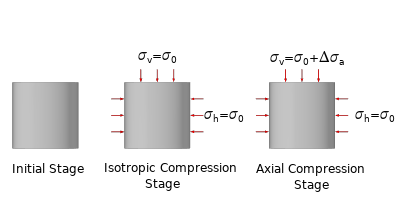
In this example, triaxial and oedometer tests are simulated using the Hardening Soil material model. Both tests exhibit a hyperbolic stress–strain relationship. For the triaxial test, it is confirmed that the axial stress approaches the analytical failure stress asymptotically. In the ... Read More
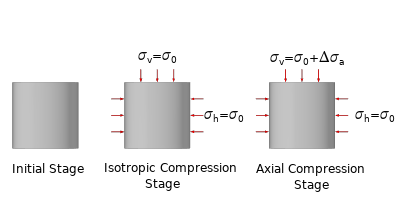
In this example, monotonic and cyclic triaxial tests are simulated using the Hardening Soil Small Strain material model. The model captures the effects of small strain stiffness and hysteresis under cyclic loading. The stress-strain relationship matches the hyperbolic curve reported in ... Read More
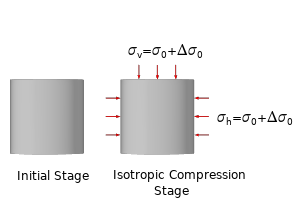
Isotropic compression is a common material test in soil mechanics. The modified Cam-Clay (MCC) model describes the relation between the void ratio and the logarithm of the pressure. In this example, a cylindrical soil sample under isotropic compression is simulated. It is verified that, ... Read More
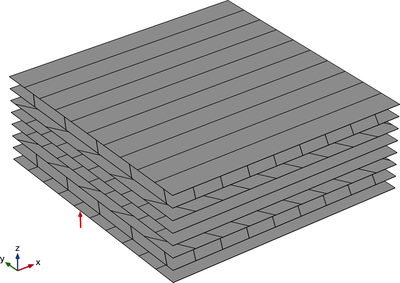
This model serves the purpose of validation and verification of the Linear Elastic Material, Layered model in the Shell interface. In COMSOL Multiphysics, composites are analyzed either based on Layerwise 3D elasticity theory through the Layered Shell interface or based on FSDT-ESL ... Read More
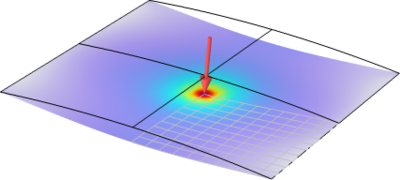
For slender structures, buckling can be a catastrophic instability if the service load exceeds the critical buckling load. For such structures, it can be important to study the structural behavior beyond the critical buckling load. Such a study is known as a postbuckling analysis. ... Read More
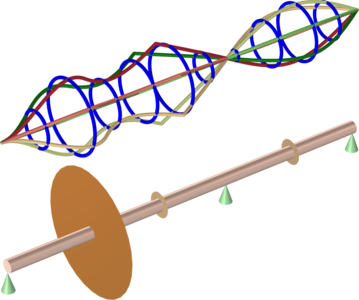
In this example, learn how to model two rotors connected by a spline coupling. The first rotor is a fixed cantilevered rotor and the second rotor is supported. The model assumes that only translational motion is coupled between the rotors through the coupling, while the rotations of both ... Read More
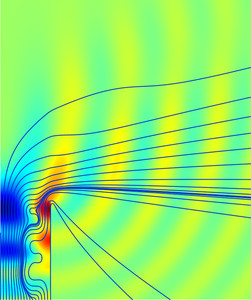
This example models the radiation of fan noise from the annular duct of a turbofan aeroengine. When the jet stream exits the duct, a vortex sheet appears along the extension of the duct wall due to the surrounding air moving at a lower speed. The near field on both sides of the vortex ... Read More
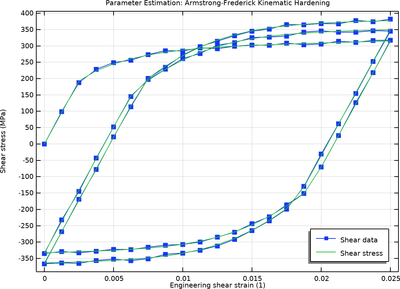
This tutorial model demonstrates how to estimate the material parameters of a combined hardening elastoplastic material model given cyclic shear data. Read More
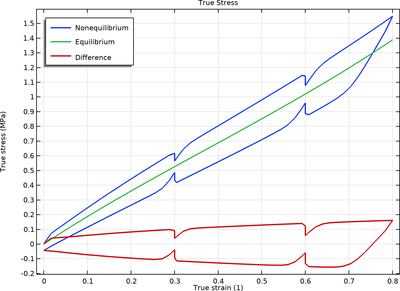
In this example, the Bergstrom–Boyce material model is used to capture the nonequilibrium behavior of carbon-black-filled chloroprene rubber under a strain history that alternates compression with relaxation. Results are verified against experimental and numerical results taken from the ... Read More
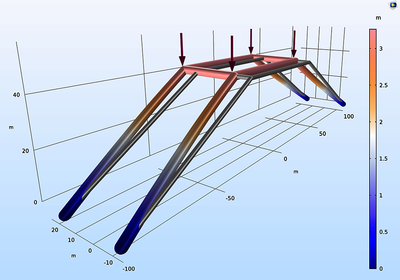
This model illustrates the instability of a space arc frame under concentrated vertical loading. The Beam interface is utilized. Two different approaches are used: A full incremental nonlinear analysis, where a small lateral load is applied to break the symmetry of the structure A ... Read More


