
The Application Gallery features COMSOL Multiphysics® tutorial and demo app files pertinent to the electrical, structural, acoustics, fluid, heat, and chemical disciplines. You can use these examples as a starting point for your own simulation work by downloading the tutorial model or demo app file and its accompanying instructions.
Search for tutorials and apps relevant to your area of expertise via the Quick Search feature. Note that many of the examples featured here can also be accessed via the Application Libraries that are built into the COMSOL Multiphysics® software and available from the File menu.
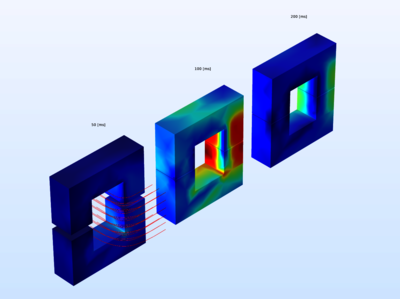
Electrical events, such as an overcurrent or overload, can seriously damage electrical circuits or power lines. To avoid expensive replacements of critical parts, circuit breakers can be installed. These mechanically interrupt the current flow or surge by moving a plunger as soon as a ... Read More
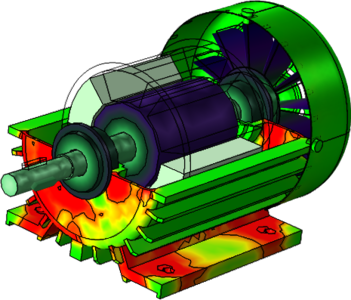
This example illustrates the modeling of an induction motor in which eddy currents are induced in the rotor by time-harmonic currents in the stator windings and by the rotor rotation. The induced currents interact with the magnetic field generated by the stator coils to produce the ... Read More
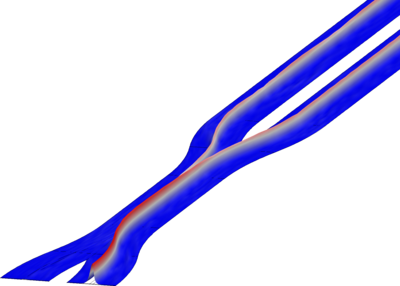
A Mach–Zehnder modulator is used for controlling the amplitude of an optical wave. The input waveguide is split into two waveguide interferometer arms. If a voltage is applied across one of the arms, a phase shift is induced for the wave passing through that arm. When the two arms are ... Read More
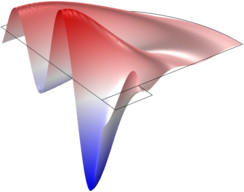
A piezoelectric transducer can be used either to transform an electric current to an acoustic pressure field or, the opposite, to produce an electric current from an acoustic field. These devices are generally useful for applications that require the generation of sound in air and ... Read More
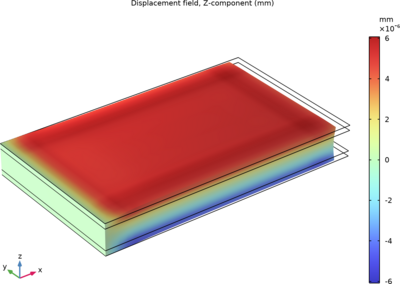
This tutorial is intended as a simple example showing how to model piezoelectric devices using the layered shell functionality. Two cases of material orientation are studied. In the first case, the pole axis is normal to the shell surface, which results in a thickness change. In the ... Read More
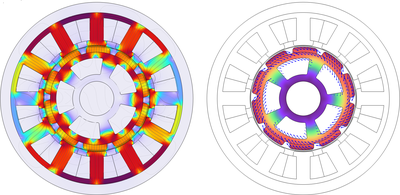
In this example, the coupling between Multibody Dynamics and Rotating Machinery, Magnetic for performing electromagnetic and mechanical analysis is demonstrated. A permanent magnet motor with 10 rotor poles and 12 stator slots is modelled in 2D. The magnets are attached to the ... Read More
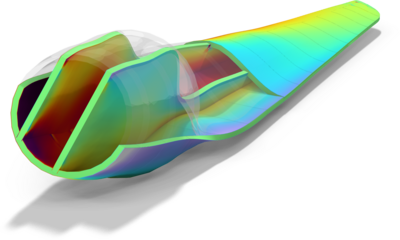
Wind turbines are an increasingly popular source of renewable energy. As such, the design, analysis and manufacture of wind turbines are important to the energy industry. The turbine blades are critical components of a wind turbine. When generating electric power through rotation, they ... Read More

As integrated circuit (IC) technology advances, with circuits becoming more powerful and compact, it is increasingly important to identify and prevent any cause of circuit failure. One particularly critical factor contributing to circuit failure is electromigration within the ... Read More
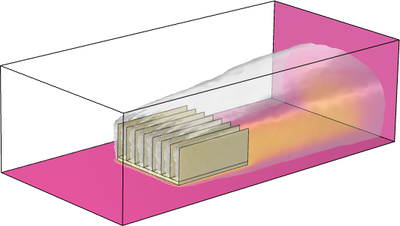
Thermoelectric elements are often used to cool or heat electronic components to a desired temperature. In such simulations, you are typically not interested in the behavior of the thermoelectric element itself but want to use its performance characteristics to model the overall response ... Read More

This model analyzes the thermal expansion in a MEMS device, such as a microgyroscope, where thermal expansion should be minimized. The device is made from the copper-beryllium alloy UNS C17500 and uses temperature-dependent material properties from the Material Library. The purpose of ... Read More


