
The Application Gallery features COMSOL Multiphysics® tutorial and demo app files pertinent to the electrical, structural, acoustics, fluid, heat, and chemical disciplines. You can use these examples as a starting point for your own simulation work by downloading the tutorial model or demo app file and its accompanying instructions.
Search for tutorials and apps relevant to your area of expertise via the Quick Search feature. Note that many of the examples featured here can also be accessed via the Application Libraries that are built into the COMSOL Multiphysics® software and available from the File menu.
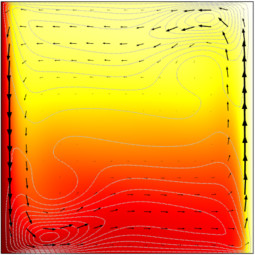
This model couples the Navier Stokes equations and the heat transfer equations to examine density driven flow of free fluids. Here the fluid is in a square cavity with a heated wall. The buoyancy force is a Boussinesq term added to the Navier-Stokes equations. The equation is ... Read More

This example shows a 2D plane stress model of a thin tapered cantilever. Different boundary and load scenarios are examined. It is demonstrated how to apply and how to evaluate different load and constraint groups. Resulting stresses are compared to NAFEMS benchmark values and they are ... Read More
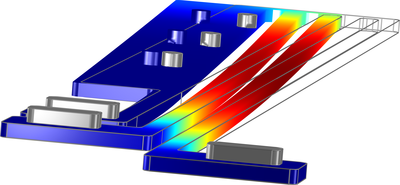
A model of a thermal microactuator requires the coupled simulation of electric current conduction with heat generation, heat conduction, and structural stresses and strains due to thermal expansion. The purpose of this model is to demonstrate how to access the cluster computing ... Read More
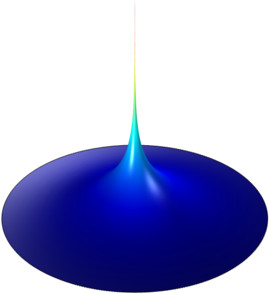
This model solves Poisson's equation on a unit disk with a point source at the origin. The mesh density is higher close to the origin to resolve the singularity. The computed solution is compared to the analytical solution. Read More

This example illustrates the principle of electrochemical polishing. The simplified 2D model geometry consists of two electrodes and an intermediate electrolyte domain The positive electrode has a protrusion, representing a surface defect. The purpose of the model is to examine how this ... Read More
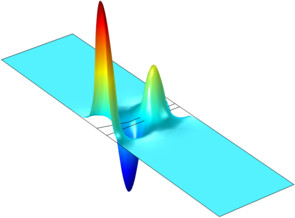
Quantum dots are nano- or microscale devices created by confining free electrons in a 3D semiconducting matrix. Those tiny islands or droplets of confined “free electrons” (those with no potential energy) present many interesting electronic properties. They are of potential importance ... Read More
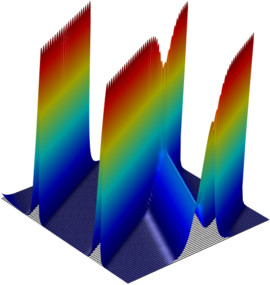
The Korteweg-de Vries (KdV) equation models water waves. It contrasts sharply to the Burgers equation, because it introduces no dissipation and the waves travel seemingly forever. Solitons have their primary practical application in optical fibers. Specifically, a fiber’s linear ... Read More
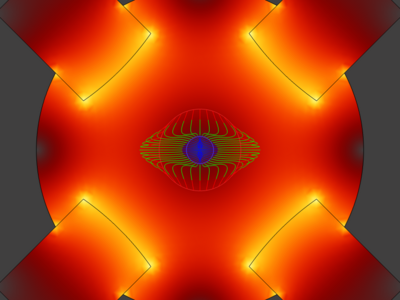
Just like optical lenses focus light, electric and magnetic lenses can be used for focusing beams of charged particles. This COMSOL Multiphysics model shows the path of B5+ ions passing through a focusing system of three magnetic quadrupoles. Each of the quadropoles focus the beam of ... Read More
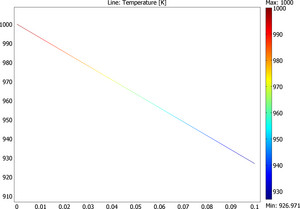
The example shows a 1D steady-state thermal analysis including radiation to a prescribed ambient temperature. The temperature field from the solution of this benchmark model is compared with a NAFEMS benchmark solution. Read More
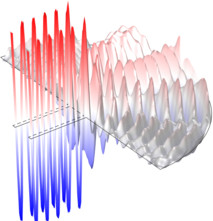
This example resembles the well-known double-slit interference experiment often demonstrated in schools with water waves or sound. The model mimics the plane-wave excitation with two thin waveguides leading to slits in a screen and computes the diffraction pattern on the opposite side of ... Read More


