
The Application Gallery features COMSOL Multiphysics® tutorial and demo app files pertinent to the electrical, structural, acoustics, fluid, heat, and chemical disciplines. You can use these examples as a starting point for your own simulation work by downloading the tutorial model or demo app file and its accompanying instructions.
Search for tutorials and apps relevant to your area of expertise via the Quick Search feature. Note that many of the examples featured here can also be accessed via the Application Libraries that are built into the COMSOL Multiphysics® software and available from the File menu.
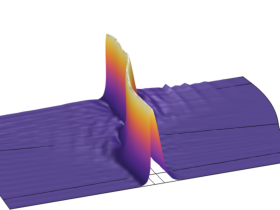
This model demonstrates how to simulate the propagation of guided waves in a dielectric S-bent optical waveguide. The model demonstrates that the phase approximation, required by the Electromagnetic Waves, Beam Envelopes interface, can be numerically calculated by solving an additional ... Read More
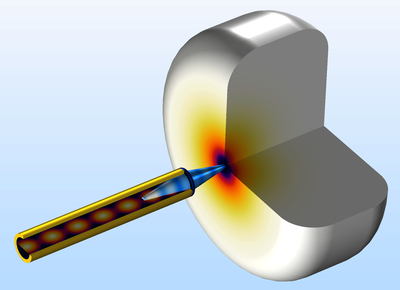
The response of a millimeter wave with frequencies of 35 GHz and 95 GHz is known to be very sensitive to water content. This model utilizes a low-power 35 GHz Ka-band millimeter wave and its reflectivity to moisture for noninvasive cancer diagnosis. Since skin tumors contain more ... Read More
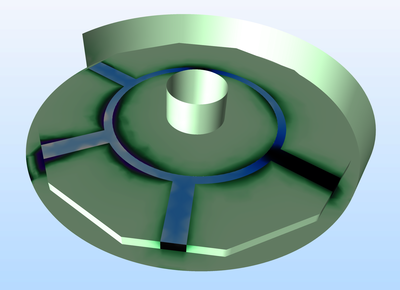
A 180° Ring Hybrid (Rat-Race Coupler) is a four-port network with 180° phase difference between two ports. It is cheaper to manufacture this type of microstrip line component compared to a wave guide 180° hybrid junction, so called magic-T. The objective of this model is to compute the S ... Read More
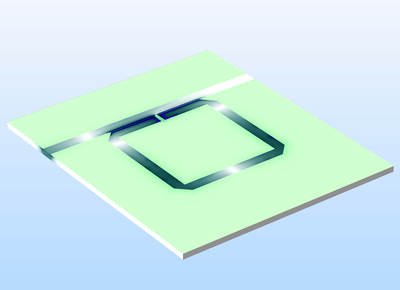
A split ring resonator (SRR) has a band-stop frequency response that rejects a certain range of frequency. This type of SRR structure is popularly used as a resonator itself and can be combined periodically to build artificial meta-materials. In this model, a printed SRR on a ... Read More
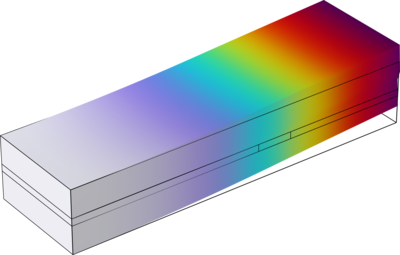
The model performs a static analysis on a piezoelectric actuator based on the movement of a cantilever beam, using the Piezoelectric Devices predefined multiphysics interface. Inspired by work done by V. Piefort and A. Benjeddou, it models a sandwich beam using the shear mode of the ... Read More
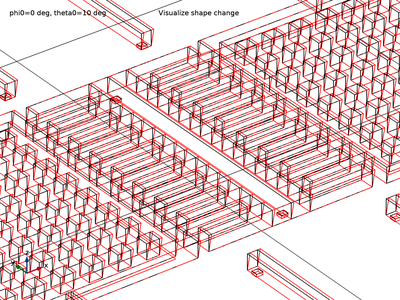
This tutorial example is kindly provided by Dr. James Ransley at Veryst Engineering, LLC. This model continues from the base model “A Micromachined Comb-Drive Tuning Fork Rate Gyroscope”, which is also provided by Dr. Ransley. The model demonstrates how to accurately compute the effects ... Read More
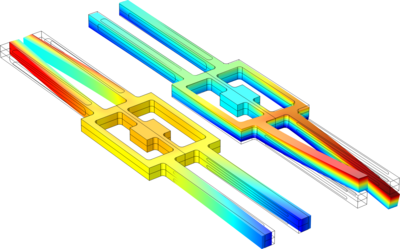
This model shows how to analyze a tuning fork based piezoelectric rate gyroscope. The reverse piezoelectric effect is used to drive an in-plane tuning fork mode. This mode is coupled to an out of plane mode by the Coriolis force and the resulting out of plane motion is sensed by the ... Read More
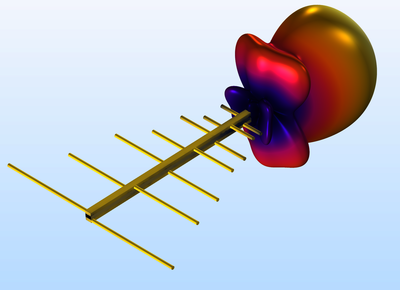
The shape of a log-periodic antenna resembles that of a Yagi-Uda antenna, but is composed of a coplanar array to achieve a wider bandwidth. It is also known as a wideband or frequency-independent antenna. All metallic parts are modeled using the perfect electric conductor (PEC) boundary ... Read More


