
The Application Gallery features COMSOL Multiphysics® tutorial and demo app files pertinent to the electrical, structural, acoustics, fluid, heat, and chemical disciplines. You can use these examples as a starting point for your own simulation work by downloading the tutorial model or demo app file and its accompanying instructions.
Search for tutorials and apps relevant to your area of expertise via the Quick Search feature. Note that many of the examples featured here can also be accessed via the Application Libraries that are built into the COMSOL Multiphysics® software and available from the File menu.
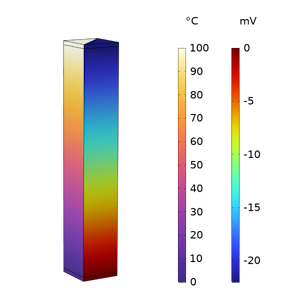
In this model, we show how to model Seebeck effect which works as a thermoelectric generator. Seebeck effect is a phenomena where the difference in temperature of a material leads to a potential difference. The potential drawn in this model was compared with the paper by Jaegle (Example ... Read More
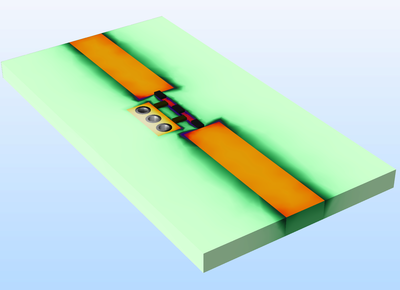
Passive devices can be designed using lumped element features if both the operating frequency of the device and the insertion loss of lumped elements are low. This example simulates two types of lumped element filters that are similar to lumped ports, except that they are strictly ... Read More
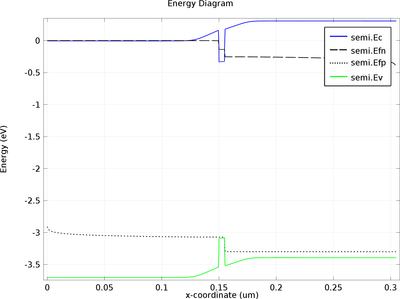
This model simulates a GaN based light emitting diode. The emission intensity, spectrum, and quantum efficiency are calculated as a function of the driving current. Direct radiative recombination across the band gap is modeled, as well as non-radiative Auger and trap-assisted ... Read More
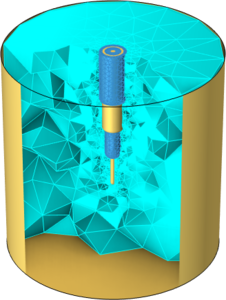
This model compares the results of five different formulations and approaches to solving an RF heating problem consisting of a coaxial cable inserted into a sample of lossy dielectric material. Results show that the different formulations agree over a wide frequency band. To learn more ... Read More
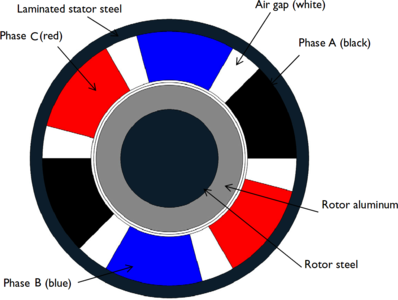
This is an example of a model of an induction motor in which the eddy currents are induced in the rotor by the time harmonic currents on the stator windings and the rotation of the rotor. In this example, we analyze the induction motor in 2D using the transient solver in the Rotating ... Read More
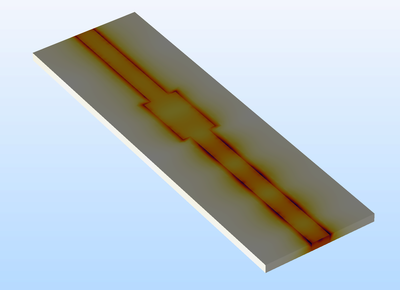
While transient analyses are useful for time domain reflectometry (TDR) to handle signal integrity (SI) problems, many RF and microwave examples are addressed using frequency domain simulations generating S-parameters. However, from the frequency domain data it is difficult to identify ... Read More
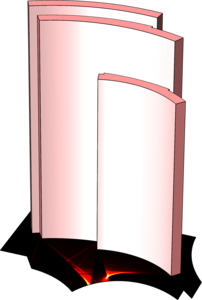
When the Vdara hotel first opened in Las Vegas, visitors relaxing by the pool would experience intense periods of heat at certain times of the day, at certain times of the year. This intense heat was caused by the reflection of solar radiation from the curved, reflective surface on the ... Read More
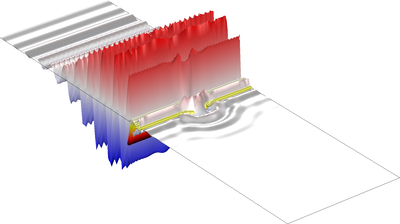
This tutorial shows how to solve the full time-dependent wave equation in dispersive media such as plasmas and semiconductors. The 2D TM in-plane wave model solves for the vector potential from the wave equation and for an auxiliary electric polarization density from an ordinary ... Read More


