
The Application Gallery features COMSOL Multiphysics® tutorial and demo app files pertinent to the electrical, structural, acoustics, fluid, heat, and chemical disciplines. You can use these examples as a starting point for your own simulation work by downloading the tutorial model or demo app file and its accompanying instructions.
Search for tutorials and apps relevant to your area of expertise via the Quick Search feature. Note that many of the examples featured here can also be accessed via the Application Libraries that are built into the COMSOL Multiphysics® software and available from the File menu.
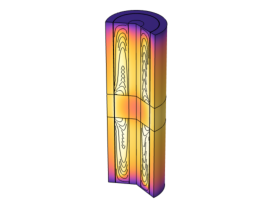
Fluid dampers are used in military devices for shock isolation and in civil structures for suppressing earthquake-induced shaking and wind-induced vibrations, among many other applications. Fluid dampers work by dissipating the mechanical energy into heat. This model shows the phenomenon ... Read More
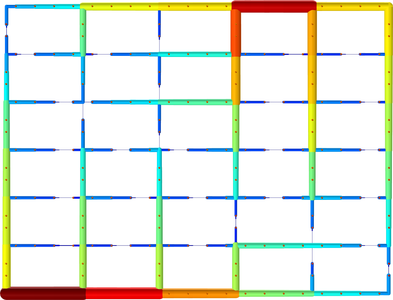
The layout of a district heating network is designed using topology optimization. Read More
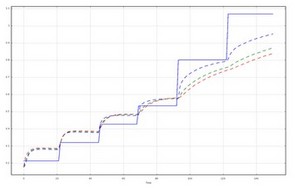
The first model describes the simultaneous flow of two immiscible fluids in porous media - here air displaces water in a multi-step inlet pressure experiment. We solve for the pressure and the degree saturation for the air and water within a representative volume and so track saturation ... Read More
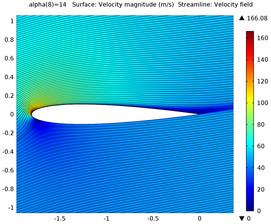
This model simulates the flow around an inclined NACA 0012 airfoil at different angles of attack using the SST turbulence model. The results show good agreement with the experimental lift data of Ladson and the pressure data of Gregory and O’Reilly. Read More
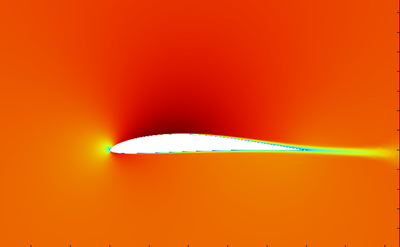
The flow around the Eppler 387 airfoil is computed with the SST turbulence model both with and without the transition model. The reuslts are compared with experimental values. Read More
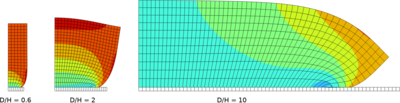
Polymer hydrogels consist of a crosslinked network of long-chained polymers that has imbibed a large number of solvent molecules. Such materials are used in many biomedical applications, such as targeted drug delivery, tissue engineering, and stimuli-sensitive actuators. This benchmark ... Read More
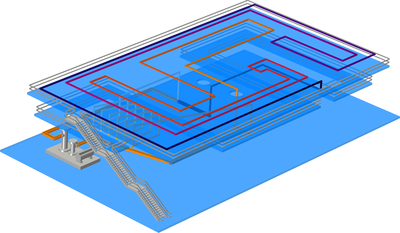
This example demonstrates how to model coupled flow, heat transfer, and structural deformation and stress in a pipeline network. Gravity loads from the pipe and fluid are also taken into account. Read More
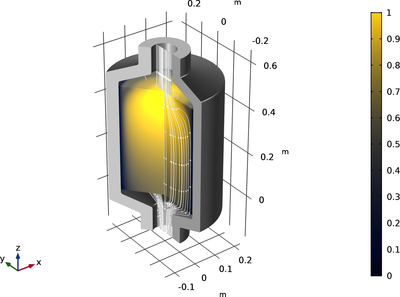
Thermal energy storage units are used to accumulate thermal energy from solar, geothermal, or waste heat sources. The simplest units are built from water tanks, often found in households, where the solar energy is stored as sensible heat. The thermal capacity of these tanks can be ... Read More
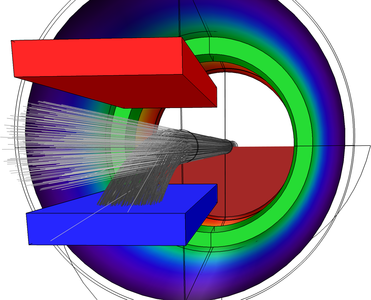
Gas cells have several applications in the design of scientific instruments. A gas cell is used to define a high-pressure region within the instrument's main vacuum system. For example, in this application, note we are designing a high-pressure region 100 mm long, with an operating ... Read More
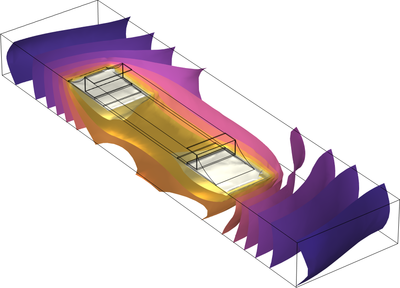
The drive for miniaturizing electronic devices has resulted in today’s extensive use of surface-mount electronic components. An important aspect in electronics design and the choice of materials is a product’s durability and lifetime. For surface-mount resistors and other components ... Read More


