
The Application Gallery features COMSOL Multiphysics® tutorial and demo app files pertinent to the electrical, structural, acoustics, fluid, heat, and chemical disciplines. You can use these examples as a starting point for your own simulation work by downloading the tutorial model or demo app file and its accompanying instructions.
Search for tutorials and apps relevant to your area of expertise via the Quick Search feature. Note that many of the examples featured here can also be accessed via the Application Libraries that are built into the COMSOL Multiphysics® software and available from the File menu.
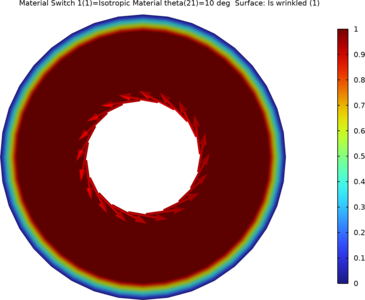
In this example, a torque is applied to the inner edge of a circular annulus-shaped membrane while the outer edge is fixed, resulting in wrinkling of the membrane. The wrinkling membrane model avoids the equilibrium instability that would be produced by the compressive stresses. The ... Read More
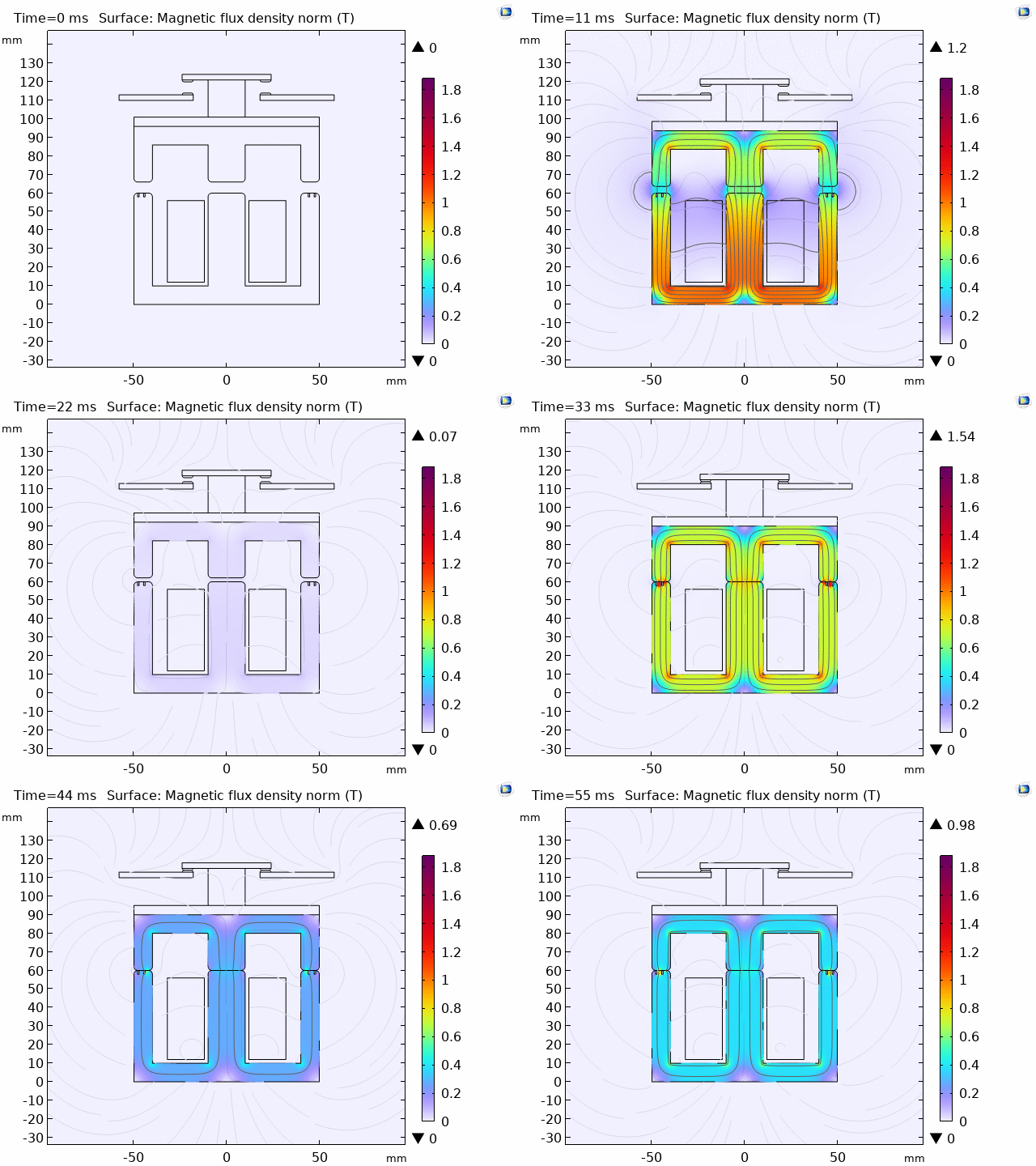
An AC contactor is a particular type of magnetic switch device, which is activated by a primary coil fed by an alternating current. Unlike DC switches, such devices can suffer from a tendency to reopen when the AC current crosses zero. The addition of a shading coil that supports ... Read More
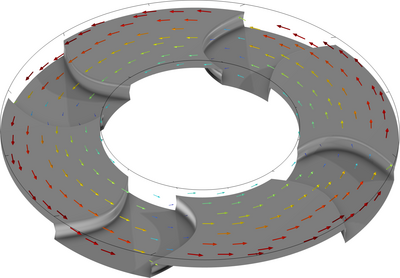
In this tutorial model, a step thrust bearing is shape optimized to maximize the bearing capacity. A step thrust bearing consists of a stepped bearing surface on which the end of the shaft rotates. The entire assembly is submerged in a lubricant. The shaft collar is assumed to be ... Read More
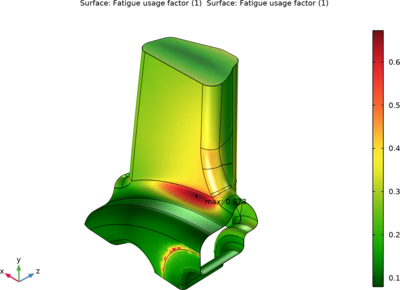
High Cycle Fatigue (HCF) of a spoke in a wheel rim is studied. As the wheel rotates, the stress histories in the structure will become nonproportional. The risk of fatigue is evaluated using the Findley criterion. Read More
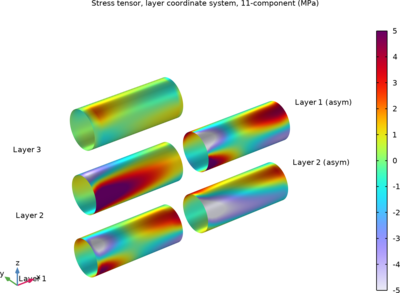
Fiber composites are widely used in industrial applications. Compared with traditional metallic engineering materials, fiber composites often offer higher specific stiffness and strength, as well as greater corrosion resistance. In addition, properties such as strength, stiffness, and ... Read More
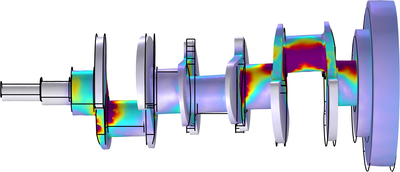
See how to perform a vibration analysis of the crankshaft of a 3-cylinder reciprocating engine in this tutorial model. Due to the eccentricity of the crank-pin and balance masses on the crankshaft, it undergoes self-excited vibration under rotation. The crankshaft is modeled using solid ... Read More
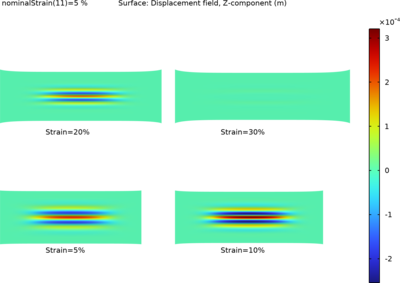
This example demonstrates the wrinkling of a thin rectangular sheet stretched uniaxially. First, a static analysis is performed to determine the region of negative principal stresses without wrinkling. Next, a prestressed buckling analysis is carried out to find out the linearized ... Read More
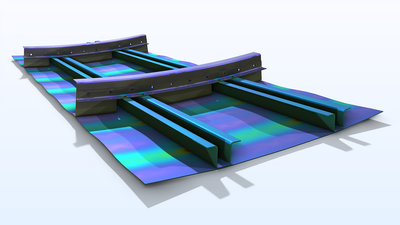
This model studies the structural deformation of an aircraft fuselage structure subjected to buckling loads. The structure is an assembly of panels and skin connected by rivets. The Fasteners feature sets up a large number of connections and computes the forces acting on each rivet. Read More


