
The Application Gallery features COMSOL Multiphysics® tutorial and demo app files pertinent to the electrical, structural, acoustics, fluid, heat, and chemical disciplines. You can use these examples as a starting point for your own simulation work by downloading the tutorial model or demo app file and its accompanying instructions.
Search for tutorials and apps relevant to your area of expertise via the Quick Search feature. Note that many of the examples featured here can also be accessed via the Application Libraries that are built into the COMSOL Multiphysics® software and available from the File menu.

Gear rattle and bearing misalignment are common sources of vibration and noise in gearboxes. This example considers two geared shafts supported by roller bearings. Backlash causes intermittent tooth contact and induces shaft vibrations when the driven shaft is unloaded and the driving ... Read More
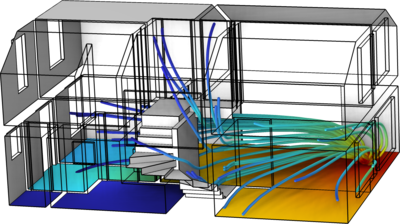
This model shows an application of the Acoustic Diffusion Equation physics interface. The acoustics in a two-story one-family house consisting of 10 rooms is analyzed. The steady state sound pressure level and energy density distributions are analyzed for a monopole source located in ... Read More
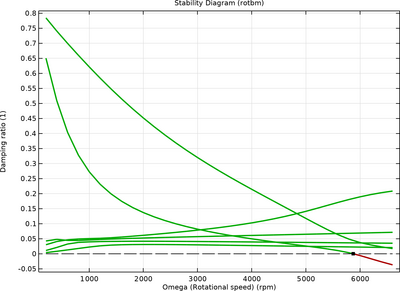
In this tutorial model, you will see how to set up an eigenfrequency analysis of a rotor with multiple disks and bearings. The example illustrates how to use Campbell and stability diagrams to identify the critical speeds and the stability threshold. The rotor is modeled using the Beam ... Read More
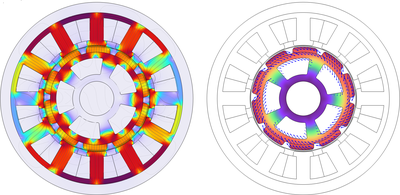
In this example, the coupling between Multibody Dynamics and Rotating Machinery, Magnetic for performing electromagnetic and mechanical analysis is demonstrated. A permanent magnet motor with 10 rotor poles and 12 stator slots is modelled in 2D. The magnets are attached to the ... Read More
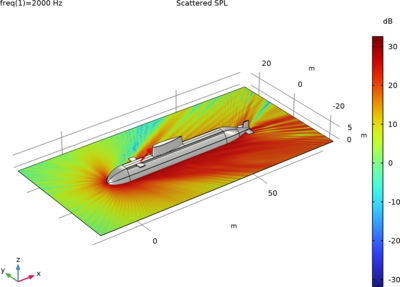
The primary defense of a submarine lies in its capacity to remain hidden during operation. As radio waves are strongly absorbed by sea water, sound navigation ranging, or SONAR, is one of the main methods used for the detection of submarines. SONAR systems are also used for underwater ... Read More
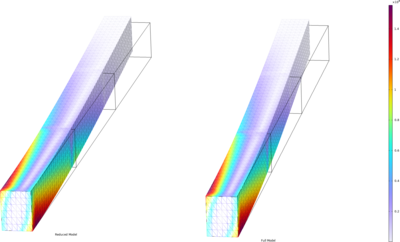
In this tutorial example, the concepts of Component Mode Synthesis (CMS) are introduced through a simple solid model of a cantilever beam. Parts of the beam are reduced by the CMS technique. It is, furthermore, shown how CMS can be used to represent both the static and dynamic behavior ... Read More
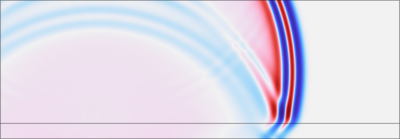
This tutorial studies the propagation of sound in the presence of a porous absorber in the time domain. It demonstrates how to model a porous absorber using the local and extended reacting approximations and compares the two approaches for absorbers of various thickness. The dissipative ... Read More
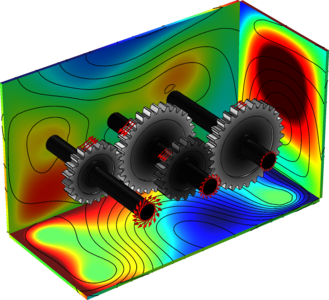
This model simulates vibrations in a compound gear train. Spur gears, used to model the gear train, are mounted on rigid shafts. The shafts are supported by an elastic housing at both ends. The gear mesh is assumed to be elastic with varying stiffness, which is the source of vibration. A ... Read More


