
The Application Gallery features COMSOL Multiphysics® tutorial and demo app files pertinent to the electrical, structural, acoustics, fluid, heat, and chemical disciplines. You can use these examples as a starting point for your own simulation work by downloading the tutorial model or demo app file and its accompanying instructions.
Search for tutorials and apps relevant to your area of expertise via the Quick Search feature. Note that many of the examples featured here can also be accessed via the Application Libraries that are built into the COMSOL Multiphysics® software and available from the File menu.
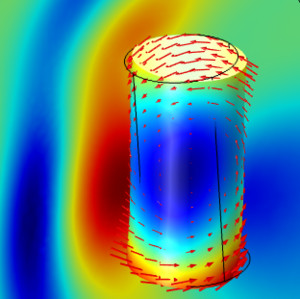
Coupling acoustics in liquids or gases with structural mechanics has applications in many engineering fields, including loudspeakers, acoustic sensors, nondestructive testing, and medical ultrasound diagnostics. This tutorial model demonstrates how to model the interaction between sound ... Read More
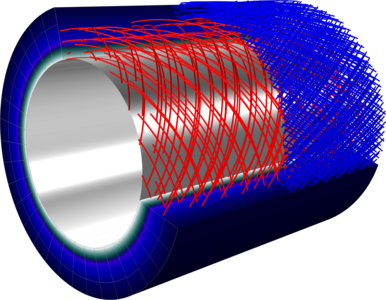
This model shows how to implement an anisotropic, incompressible, hyperelastic material for modeling soft collagenous tissue in arterial walls. The hyperelastic material model implemented is based on the articles: Holzapfel, G. A., Gasser, T. C., & Ogden, R. W. (2000), A new ... Read More
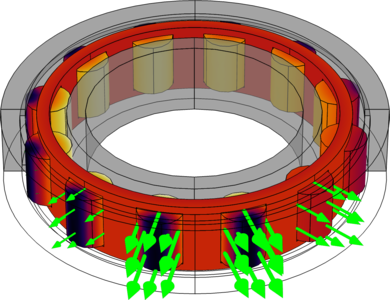
Bearings are used in machines to reduce the friction between moving parts and thereby smooth their relative motion. Rolling element bearings are one of the most widely used bearings, where rolling elements or rollers are used to support the load. These rollers can be of different shapes; ... Read More
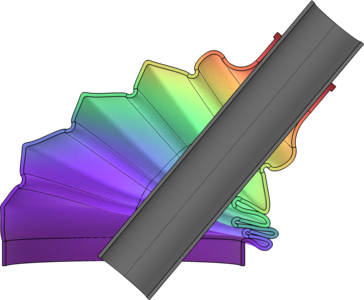
In this example, the deformation of a rubber boot seal connected to a rigid pipe is studied. As the pipe rotates and the seal deforms, the flanges of the seal self-intersect and it also come into contact with the pipe. Read More
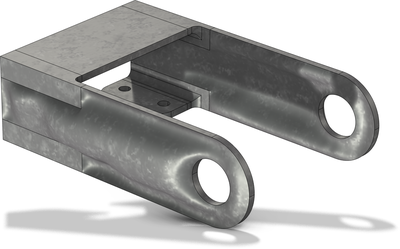
In his example, the lowest natural frequency of a 3D bracket are maximized using shape optimization. Read More
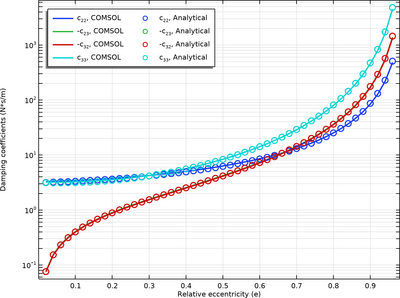
Squeeze film dampers are components that provide additional damping to rotating machines. To simplify the modeling of a rotor assembly, squeeze film dampers are modeled in terms of their damping coefficients which are a functions of the journal location in the damper. This model computes ... Read More
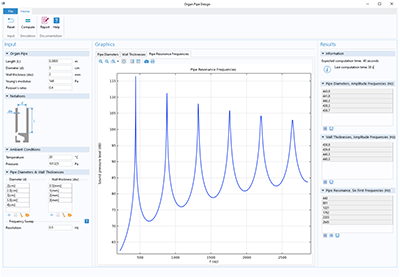
This app demonstrates the following: Using a Java® utility class for combining several waveforms and for playing sound Using tables for presenting results The app allows you to study the design of an organ pipe and then play the sound and pitch of the changed design. The pipe sound ... Read More
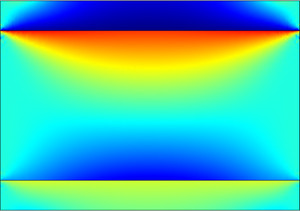
The thermal stress in a layered plate is studied in this example. A plate consisting of two layers, a coating and a substrate layer, is stress and strain free at 800 degrees C. The temperature of the plate is reduced to 150 degrees C and thermal stresses are induced due to the difference ... Read More


