
The Application Gallery features COMSOL Multiphysics® tutorial and demo app files pertinent to the electrical, structural, acoustics, fluid, heat, and chemical disciplines. You can use these examples as a starting point for your own simulation work by downloading the tutorial model or demo app file and its accompanying instructions.
Search for tutorials and apps relevant to your area of expertise via the Quick Search feature. Note that many of the examples featured here can also be accessed via the Application Libraries that are built into the COMSOL Multiphysics® software and available from the File menu.
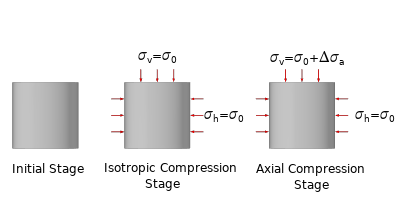
In this example, triaxial and oedometer tests are simulated using the Hardening Soil material model. Both tests exhibit a hyperbolic stress–strain relationship. For the triaxial test, it is confirmed that the axial stress approaches the analytical failure stress asymptotically. In the ... Read More
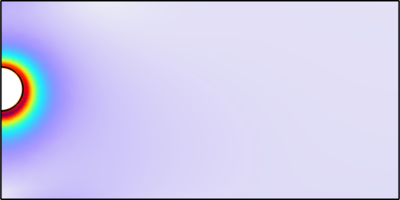
This example models the behavior of soil during a tunnel excavation. The surface settlement and the width of the plastic region around the tunnel are important parameters needed to predict required reinforcements during the excavation. Two study steps are used. The first study computes ... Read More
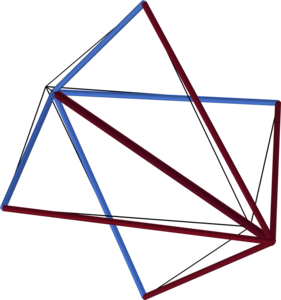
Trusses are structural members that can only sustain axial forces, but no bending or torsion. In the following example you first build and solve a simple 2D truss model using the 2D Truss interface. Later on, you analyze a 3D variant of the same problem using the 3D Truss interface. This ... Read More
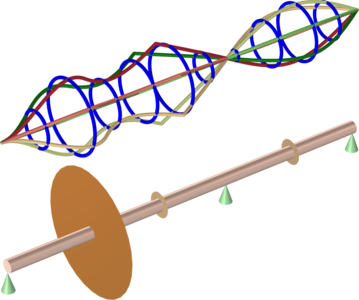
In this example, learn how to model two rotors connected by a spline coupling. The first rotor is a fixed cantilevered rotor and the second rotor is supported. The model assumes that only translational motion is coupled between the rotors through the coupling, while the rotations of both ... Read More
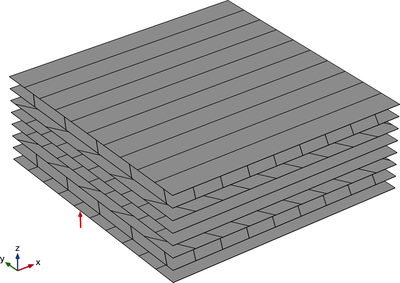
This model serves the purpose of validation and verification of the Linear Elastic Material, Layered model in the Shell interface. In COMSOL Multiphysics, composites are analyzed either based on Layerwise 3D elasticity theory through the Layered Shell interface or based on FSDT-ESL ... Read More

A thin-walled frame with a central cutout is subjected to a random load. Although the stresses are far below the yield level of the material, damage accumulates over the load history. The Rainflow counting algorithm is used to define the load scenario and Palmgren-Miner linear damage ... Read More
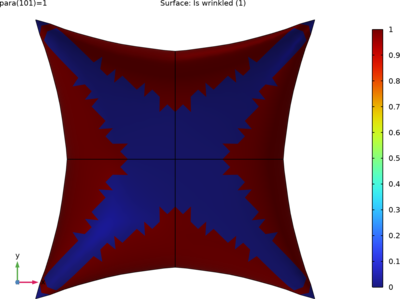
A square airbag is inflated using constant air pressure. In some regions of the airbag the material wrinkles during inflation, as negative principal stresses develop. The wrinkling membrane model within the tension field theory gives a correct description of the stress distribution and ... Read More
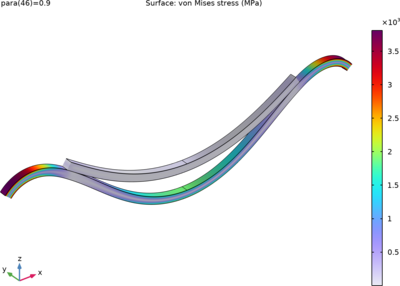
This conceptual example shows how to calculate critical points in models with contact. The model consists of two contacting arches modeled with the Shell interface. The contact problem is solved using the penalty method. The upper arch is loaded with displacement controlled edge loads ... Read More


