
The Application Gallery features COMSOL Multiphysics® tutorial and demo app files pertinent to the electrical, structural, acoustics, fluid, heat, and chemical disciplines. You can use these examples as a starting point for your own simulation work by downloading the tutorial model or demo app file and its accompanying instructions.
Search for tutorials and apps relevant to your area of expertise via the Quick Search feature. Note that many of the examples featured here can also be accessed via the Application Libraries that are built into the COMSOL Multiphysics® software and available from the File menu.
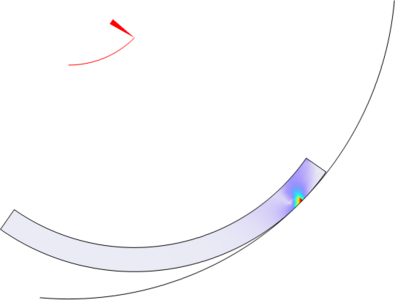
This is a benchmark model involving stick-slip behavior of a ring rolling inside another ring. The displacement of the inner ring is computed and compared to the analytical result. This model also shows how to tackle friction-dominated contact problem. Read More
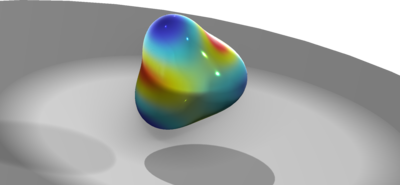
In this tutorial, the eigenmodes and eigenfrequencies of an air bubble in water are modeled and compared with analytical solutions. The effects of surface tension are included, allowing both the pulsating mode and the surface modes of the bubble to be modeled. Lastly, the effect of the ... Read More
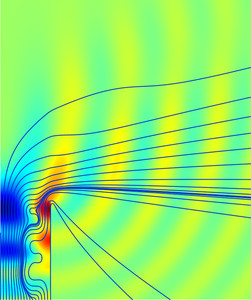
This example models the radiation of fan noise from the annular duct of a turbofan aeroengine. When the jet stream exits the duct, a vortex sheet appears along the extension of the duct wall due to the surrounding air moving at a lower speed. The near field on both sides of the vortex ... Read More
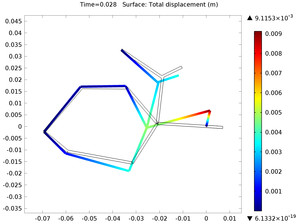
This benchmark model simulates the rigid body dynamics of Andrew’s squeezing mechanism. The mechanism is force driven and exhibits dynamics over a very short time scale. The computed angles of various components in the mechanism are compared with reference results to validate the model. Read More
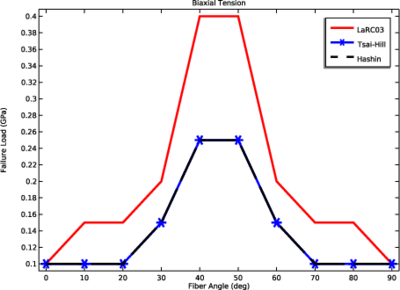
Laminated composite shells made from graphite–epoxy fiber-reinforced plies are widely used in many applications due to their high strength-to-weight ratio. Evaluating their structural integrity under applied loads is essential for ensuring reliable designs. This example demonstrates ... Read More
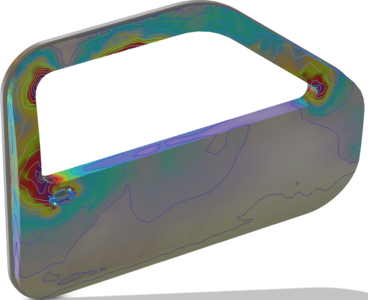
This model illustrates the dynamics of a car door assembly during a slam event. The system consists of a car body, a door, and rubber seals. Contact pairs are defined between the car body, rubber seals, and the door. The rubber seal is modeled using a hyperelastic material model. A ... Read More
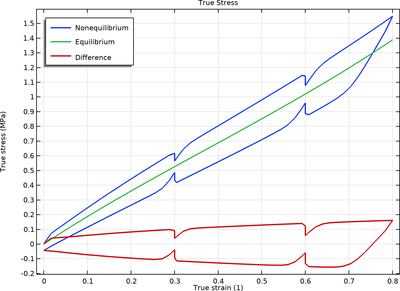
In this example, the Bergstrom–Boyce material model is used to capture the nonequilibrium behavior of carbon-black-filled chloroprene rubber under a strain history that alternates compression with relaxation. Results are verified against experimental and numerical results taken from the ... Read More
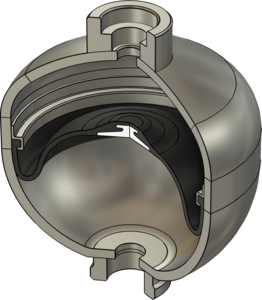
Diaphragm accumulators are essential components that store energy and regulate hydraulic systems. A flexible rubber diaphragm divides the hydraulic fluid from a compressible inert gas, typically nitrogen. These accumulators perform multiple tasks, such as temporarily storing hydraulic ... Read More


