
The Application Gallery features COMSOL Multiphysics® tutorial and demo app files pertinent to the electrical, structural, acoustics, fluid, heat, and chemical disciplines. You can use these examples as a starting point for your own simulation work by downloading the tutorial model or demo app file and its accompanying instructions.
Search for tutorials and apps relevant to your area of expertise via the Quick Search feature. Note that many of the examples featured here can also be accessed via the Application Libraries that are built into the COMSOL Multiphysics® software and available from the File menu.
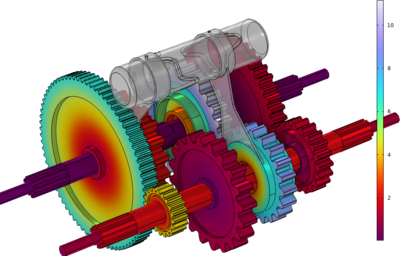
This example illustrates the modeling of a sequential manual transmission, where the gears are selected sequentially with the help of a rotating drum. The shift drum has two grooves of specific profile carved around the circumference. As the drum rotates, the grooves on the drum guide a ... Read More

This tutorial application demonstrates how to model a hinge joint between two bodies in COMSOL Multiphysics. It also demonstrates various features available for joints, including Constraints, Locking, Spring, Damper, Prescribed Motion, and Friction. Many real structures can be ... Read More

This model simulates the dynamics of a shock absorber used in an aircraft landing gear mechanism. It analyzes the stresses and heat generated in the landing gear components due to energy dissipated by the shock absorber. A prismatic joint with a spring and damper is used to model the ... Read More
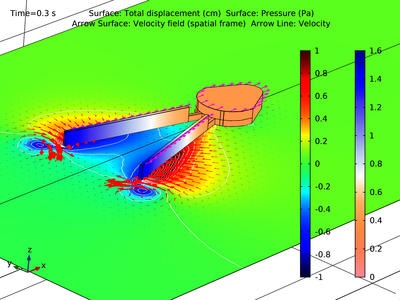
This example illustrates the modeling of a multibody mechanism submerged in a fluid. The mechanism consists of two fins connected to a central rigid body through hinge joints. A transient fluid–structure interaction analysis is performed to simulate the swimming behavior of the ... Read More
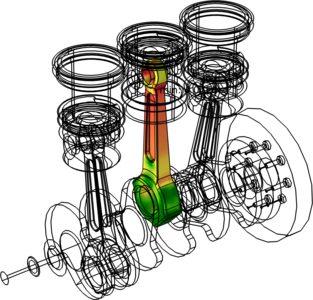
In a reciprocating piston engine, the connecting rods are subjected to high cyclic stresses that increase with engine speed. Because failure of a critical component can lead to failure of the engine, fatigue life is an important consideration in the design of these components. In this ... Read More
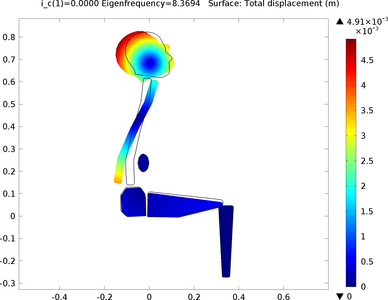
This example presents a biomechanical model of the human body for evaluating its dynamic response to vertical vibrations in a seated posture. Such models can be used to predict the response of the human body in vibration environments and have applications in ride quality analysis and the ... Read More
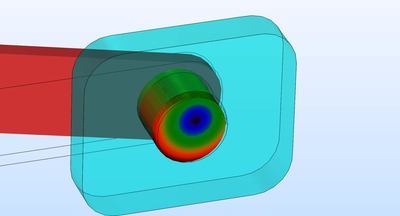
Clearance between connected components is often introduced to facilitate assembly and allow relative motion. However, clearance in joints can generate impact forces that adversely affect system performance and lead to noise and vibration. This model compares the dynamic behavior of a ... Read More
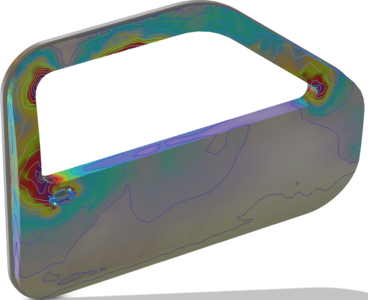
This model illustrates the dynamics of a car door assembly during a slam event. The system consists of a car body, a door, and rubber seals. Contact pairs are defined between the car body, rubber seals, and the door. The rubber seal is modeled using a hyperelastic material model. A ... Read More
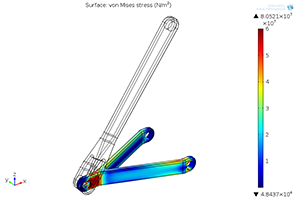
This example illustrates how to model a barrel hinge connecting two solid objects in an assembly. Because the details of the connection are not the focus of the analysis, the hinge is modeled using a Joint feature in the Multibody Dynamics Module. The connected parts can be rigid or ... Read More
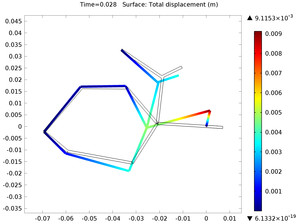
This benchmark model simulates the rigid body dynamics of Andrew’s squeezing mechanism. The mechanism is force driven and exhibits dynamics over a very short time scale. The computed angles of various components in the mechanism are compared with reference results to validate the model. Read More


