
The Application Gallery features COMSOL Multiphysics® tutorial and demo app files pertinent to the electrical, structural, acoustics, fluid, heat, and chemical disciplines. You can use these examples as a starting point for your own simulation work by downloading the tutorial model or demo app file and its accompanying instructions.
Search for tutorials and apps relevant to your area of expertise via the Quick Search feature. Note that many of the examples featured here can also be accessed via the Application Libraries that are built into the COMSOL Multiphysics® software and available from the File menu.
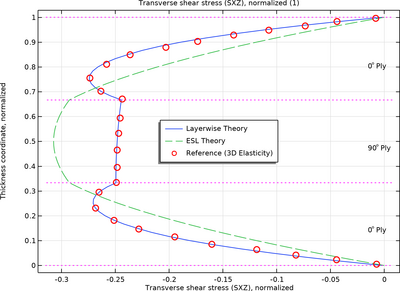
This example demonstrates the bending analysis of a simply supported composite laminate under sinusoidal distributed transverse load. The composite laminate is thick, with a thickness to side length ratio of 1/4. The laminate has three layers in a cross-ply layup. The model is solved ... Read More
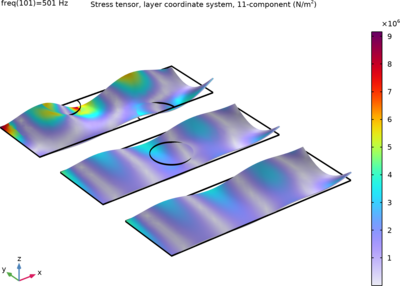
Delamination or the separation of layers is a common failure mode in laminated composite materials. Various factors, including loading, defects in the material, and environmental conditions can trigger the initiation and propagation of layer separation. This leads to degraded structural ... Read More
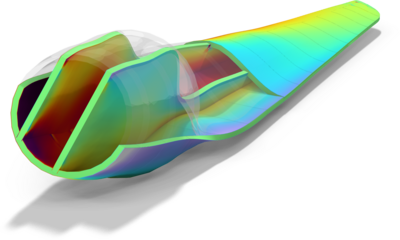
Wind turbines are an increasingly popular source of renewable energy. As such, the design, analysis and manufacture of wind turbines are important to the energy industry. The turbine blades are critical components of a wind turbine. When generating electric power through rotation, they ... Read More
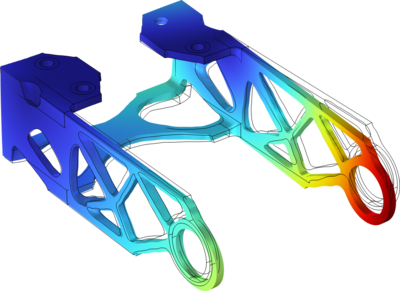
This example shows how to perform a topology optimization with several load and constraint cases. The density feature for topology optimization is used together with a parametric sweep where each optimized solution is used as input for a further improved optimization. The final ... Read More
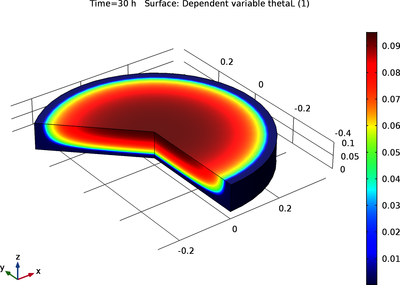
Vacuum drying is a chemical process frequently used in the pharmaceutical and food industries to remove water or an organic solvent from a wet powder. When designing a vacuum drying system, engineers aim to minimize the drying time while maintaining high quality in the product. This ... Read More
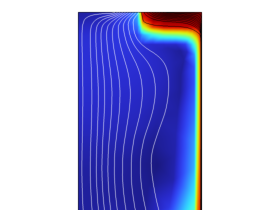
In this first half of a two-part example, a 2D model of a trench-gate IGBT is built, which will be extended to 3D in the second half. In general, it is the most efficient to start with a 2D model to make sure everything works as expected, before extending it to 3D. The Caughey&ndash ... Read More
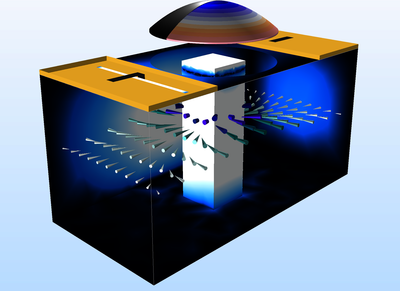
An evanescent mode cavity filter can be realized by adding a structure inside of the cavity. This structure changes the resonant frequency lower than the dominant mode of the unfilled cavity. A piezo actuator is used to control the size of a small air gap which provides the tunability of ... Read More
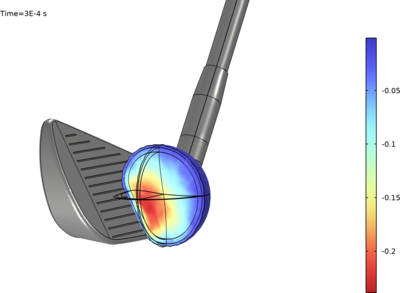
In this example, the mechanical impact of a golf club hitting a golf ball is studied. The contact between the two parts is modeled using a viscous penalty formulation to stabilize the dynamic event. To properly model the large deformation, the golf ball is defined using a hyperelastic ... Read More
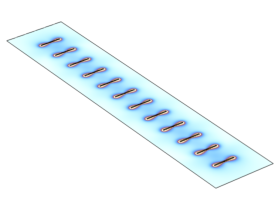
This example of a dipole antenna array demonstrates a cost-effective analysis using the Boundary Element Method (BEM). When dealing with a large array made of metallic radiators, the Finite Element Method (FEM) would necessitate greater computational resources. The simulation results ... Read More
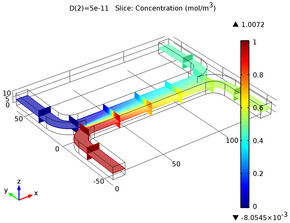
This model simulates an H-shaped micro-cell designed for diffusion-controlled separation. The cell puts two different laminar streams in contact for a controlled period of time. The contact surface is well-defined and, by controlling the flow rate, it is possible to control the amount of ... Read More


