
The Application Gallery features COMSOL Multiphysics® tutorial and demo app files pertinent to the electrical, structural, acoustics, fluid, heat, and chemical disciplines. You can use these examples as a starting point for your own simulation work by downloading the tutorial model or demo app file and its accompanying instructions.
Search for tutorials and apps relevant to your area of expertise via the Quick Search feature. Note that many of the examples featured here can also be accessed via the Application Libraries that are built into the COMSOL Multiphysics® software and available from the File menu.
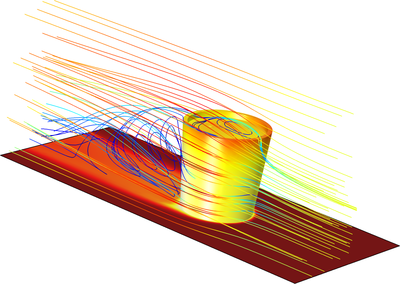
This tutorial shows how to couple three physics interfaces to model evaporative cooling. The effects that need to be taken into account are heat transfer, transport of water vapor, and fluid flow. The Wet Surface feature is used to implement the source term for the water vapor and to ... Read More
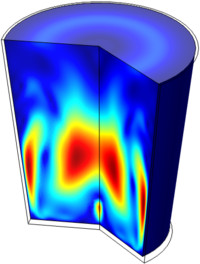
This model treats the free convection and heat transfer of a glass of cold water heated to room temperature. Initially, the glass and the water are at 5 °C and are then put on a table in a room at 25 °C. The nonisothermal flow is coupled to heat transfer using the Heat Transfer module. Read More
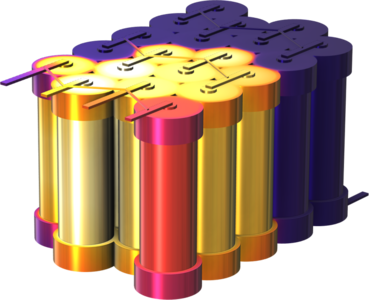
Due to abuse, such as internal or external short circuits or excessive heating, an individual battery cell may go into thermal runaway, during which the battery cell generates a significant amount of heat. If enough heat is transferred between adjacent cells during a thermal runaway ... Read More
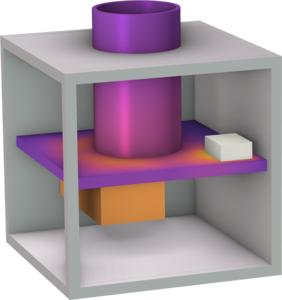
This model demonstrates how to compute satellite temperature over multiple orbit periods by coupling Orbital Thermal Loads to Heat Transfer in Solids. The direct solar, albedo, and Earth infrared thermal loads are computed over a single orbit, and are periodically repeated over multiple ... Read More
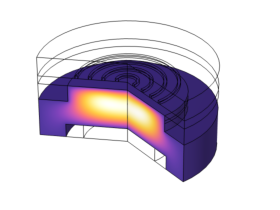
This tutorial model solves for an inductively coupled plasma reactor with RF bias (also known as ICP/CCP reactors) in a mixture of argon/chlorine. The model computes the fluid flow and gas heating. Important aspects and strategies for modeling electronegative discharges are discussed. Read More
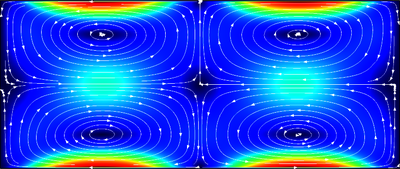
Recent advances in the fabrication of microfluidic systems require handling of live cells and other micro particles as well as mixing. All this can, for example, be achieved using acoustic radiation forces and the viscous drag from the streaming flow. Streaming: Due to the nonlinear ... Read More
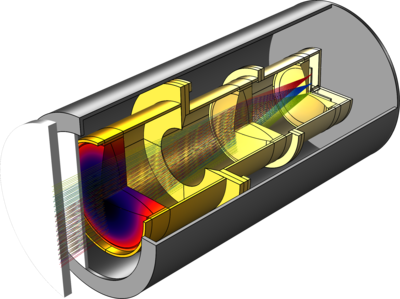
This model demonstrates an integrated structural-thermal-optical performance (STOP) analysis of an optical system. The Petzval Lens tutoral is used as the basis for this model, together with a simple barrel geometry The isothermal model performs a Parametric Sweep over several uniform ... Read More
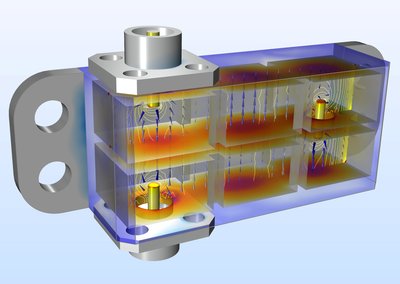
This example investigates the electrical performance of a cascaded cavity filter operating in the millimeter-wave 5G band with temperature changes. The thermal variations result in structural deformations of the structure. Thus, the resonant frequencies of the filter elements (cavities) ... Read More
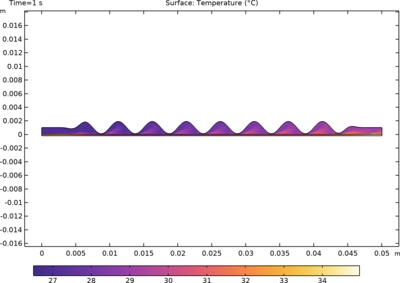
The heat exchanger in this tutorial model contains a dynamic wall with an oscillating wave shape. The deformation induces mixing in the fluid and reduces the formation of thermal boundary layers. Hence, it increases heat transfer between the walls and the fluid. In addition, the wave ... Read More
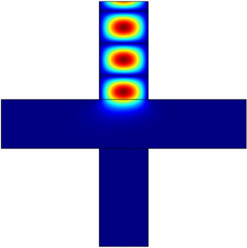
Wave heated discharges may be very simple, where a plane wave is guided into a reactor using a waveguide, or very complicated as in the case with ECR (electron cyclotron resonance) reactors. In this example, a wave is launched into reactor and an Argon plasma is created. The wave is ... Read More