
The Application Gallery features COMSOL Multiphysics® tutorial and demo app files pertinent to the electrical, structural, acoustics, fluid, heat, and chemical disciplines. You can use these examples as a starting point for your own simulation work by downloading the tutorial model or demo app file and its accompanying instructions.
Search for tutorials and apps relevant to your area of expertise via the Quick Search feature. Note that many of the examples featured here can also be accessed via the Application Libraries that are built into the COMSOL Multiphysics® software and available from the File menu.
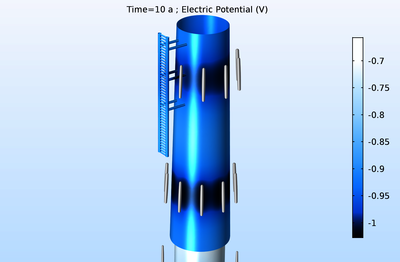
A monopile foundation is a large-diameter structural element that can be used to support structures like offshore wind turbines. This application exemplifies how the cathodic protection of a monopile decreases over time as the sacrificial anodes dissolve. The model can be used to ... Read More

This application uses the shrinking core model to study the reduction of iron ore pellets. A 1D model of a packed bed containing iron ore pellets is modeled. The bed filling pellets initially consists of solid phase FeO. The pellets are reduced by CO, and the solid core shrinks leaving a ... Read More
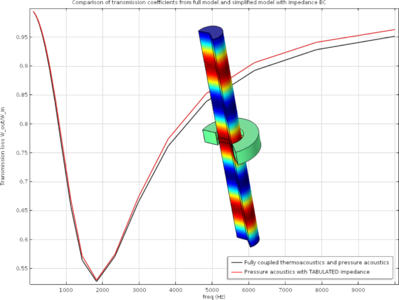
This application illustrates a modeling approach for deriving physically consistent simplified models in the Acoustics Module. The approach consists of converting complex sub-components to an impedance boundary condition and otherwise using simple acoustics throughout the COMSOL model. ... Read More
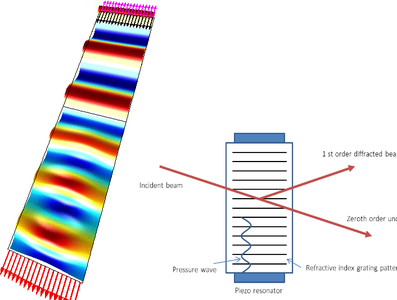
An acousto-optic modulator (AOM) is a device which can be used for controlling the power, frequency or spatial direction of a laser beam with an electrical drive signal. It is based on the acousto-optic effect, that is, the modification of the refractive index by the oscillating ... Read More
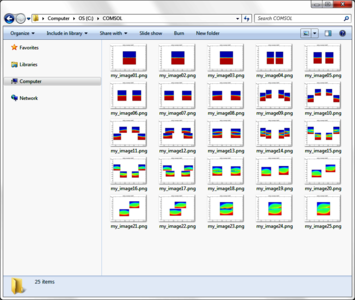
This example demonstrates how to use a parameterized slice plot and animation functionality to export a sequence of images. In addition, the example shows how to use a job sequence to perform a programmatic sequence of operations where the model is first solved and then the image ... Read More
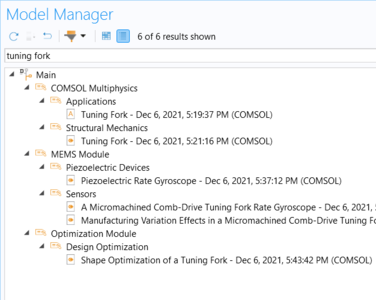
This local demo database for the Model Manager contains an imported copy of the Application Library models in COMSOL Multiphysics® version 6.0 and above. You can add this database from COMSOL Multiphysics® by selecting Download Demo Database for Model Manager from the ... Read More
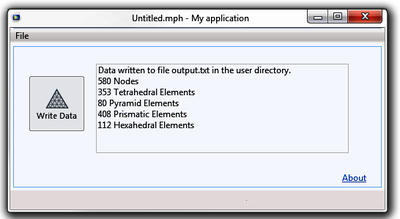
This example exemplifies how you can export the data from your mesh and results to a text file. A more detailed description of the phenomenon and the modeling process can be seen in the blog post "Exporting Meshes and Solutions Using the Application Builder". Read More
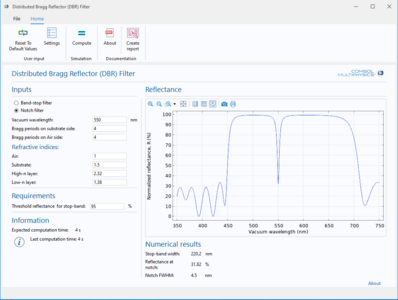
A distributed Bragg reflector (DBR) is a periodic structure formed from alternating dielectric layers that can be used to achieve nearly total reflection within a range of frequencies. The main advantage of DBRs over ordinary metallic mirrors is that DBRs can be engineered to have custom ... Read More
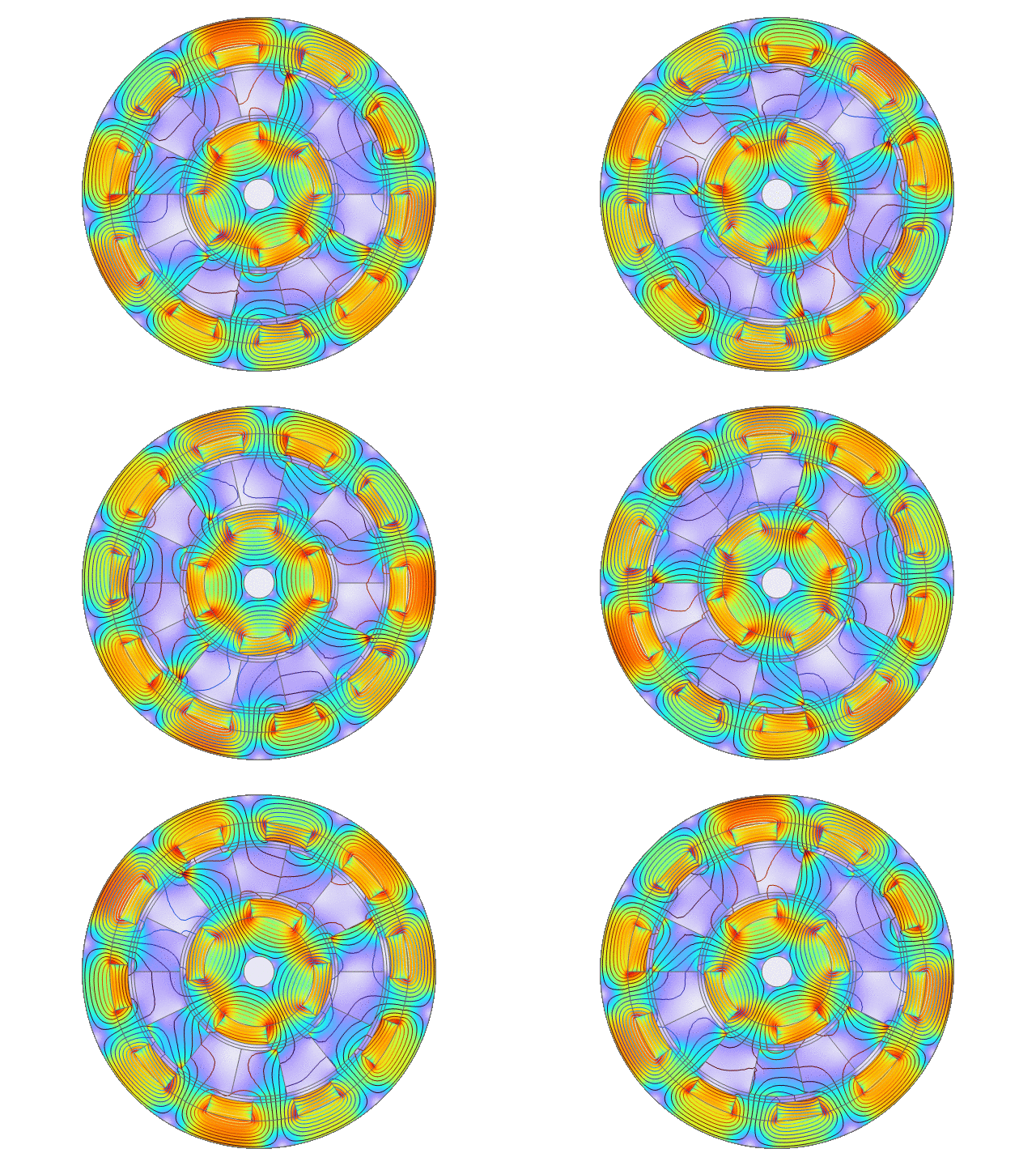
This model presents the transient modeling of a coaxial magnetic bearing using permanent magnets. The coaxial magnetic bearing is advantageous over the conventional mechanical gear mainly because of minimum noise, maintenance free operation, overload protection and physical isolation ... Read More

This example exemplifies how to model a Koch snowflake using the Application Builder. A more detailed description of the phenomenon and the modeling process can be seen in the blog post "Using the Application Builder to Create a Koch Snowflake". Read More


