
The Application Gallery features COMSOL Multiphysics® tutorial and demo app files pertinent to the electrical, structural, acoustics, fluid, heat, and chemical disciplines. You can use these examples as a starting point for your own simulation work by downloading the tutorial model or demo app file and its accompanying instructions.
Search for tutorials and apps relevant to your area of expertise via the Quick Search feature. Note that many of the examples featured here can also be accessed via the Application Libraries that are built into the COMSOL Multiphysics® software and available from the File menu.
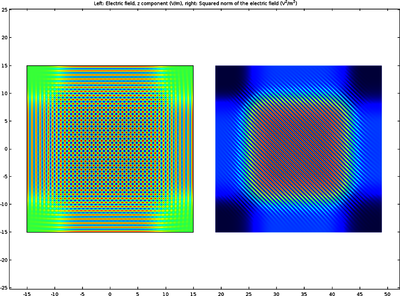
When two coherent light beams intersect, an interference pattern appears. If this occurs in a material that is sensitive to light, with intensities greater than a certain exposure threshold, the interference pattern is recorded in the material as a modulation of the refractive index and ... Read More
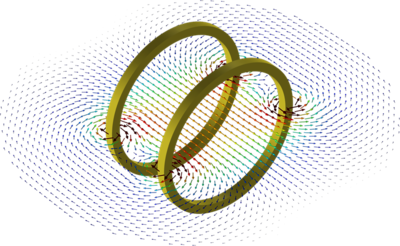
A Helmholtz coil is a parallel pair of identical circular coils spaced one radius apart and wound so that the current flows through both coils in the same direction. This winding results in a uniform magnetic field between the coils with the primary component parallel to the axes of the ... Read More
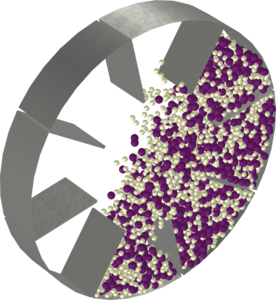
This model simulates the mixing of two types of grains in a rotating drum with baffles. The effect of the number of baffles on the mixing is demonstrated by varying the number of baffles in the drum. This model also demonstrates how to build and run a model method that evaluates the ... Read More
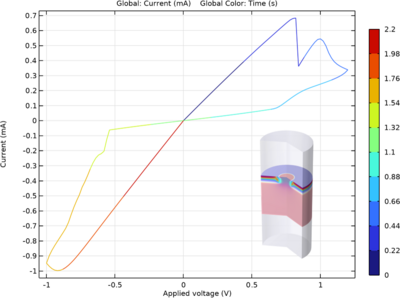
This model captures the dynamic resistive switching behavior of an oxide-based memristor. The device features a thin metal oxide layer sandwiched between two metal electrodes. When a voltage is applied, oxygen vacancies within the oxide layer migrate, acting as charge carriers and ... Read More

In a gearbox, vibrations due to gear rattling and bearing misalignment are well known sources of noise. In this example, two shafts connected through a pair of gears are considered. The shafts are supported on roller bearings at their ends. Initially, the driven shaft is unloaded and the ... Read More
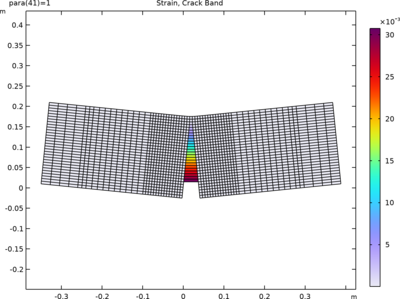
In this example, two model for brittle damage are used to evaluate the fracture of a notched concrete beam subjected to three point bending. The results are compared with experimental data. Read More
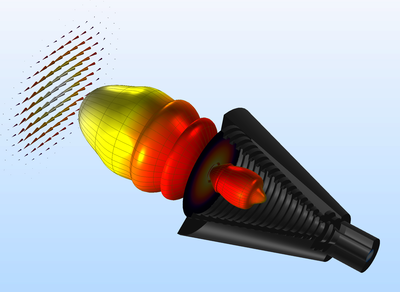
Corrugated circular aperture (conical) horn antennas are popularly used as feed horns for dish reflector antennas due to their low sidelobes and cross-polarization level. The excited TE mode from a circular waveguide passes along the corrugated inner surface of a circular horn antenna, ... Read More
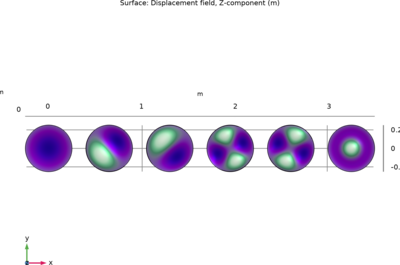
This example studies the natural frequencies of a pretensioned membrane exhibiting stress stiffening. The model results are compared with the analytical solution. Two different techniques for generating the prestress are explored. Read More
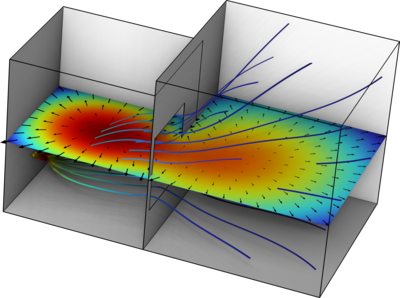
This verification model analyzes the acoustics of two coupled rooms using the Acoustic Diffusion Equation interface of the Acoustics Module. The results of the model agree with numerical results that are validated against measurements in a reference paper. Read More
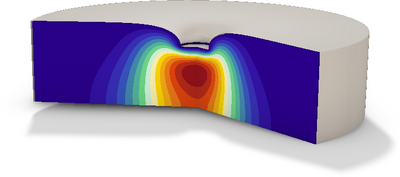
This example demonstrates how to use the Poroelasticity multiphysics coupling between the Solid Mechanics and Darcy's Law interfaces to model linear biphasic poroviscoelastic behavior of soft biological tissues. The implementation is verified using two numerical benchmarks from the ... Read More


