
The Application Gallery features COMSOL Multiphysics® tutorial and demo app files pertinent to the electrical, structural, acoustics, fluid, heat, and chemical disciplines. You can use these examples as a starting point for your own simulation work by downloading the tutorial model or demo app file and its accompanying instructions.
Search for tutorials and apps relevant to your area of expertise via the Quick Search feature. Note that many of the examples featured here can also be accessed via the Application Libraries that are built into the COMSOL Multiphysics® software and available from the File menu.
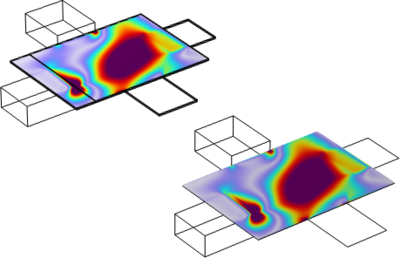
Layered shell elements, which are used for modeling composite shells, often connected to solid and shell elements in cladding or side-by-side configuration to represent a realistic structure. For such applications, it becomes important to connect layered shell element correctly and ... Read More
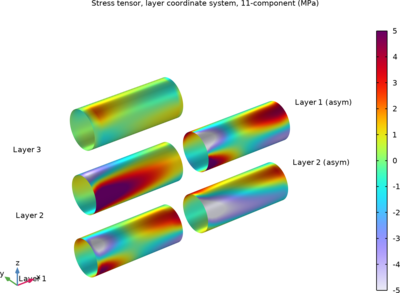
Fiber composites are widely used in industrial applications. Compared to more traditional metallic engineering materials, fiber composites often have superior specific stiffness and strength properties, and they are often more corrosion resistant. Also, properties like strength, ... Read More
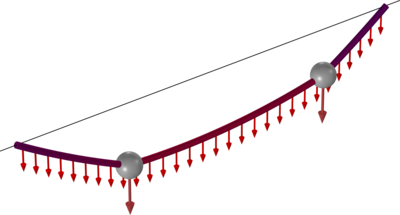
A cable is a structural member which has stiffness only in its tangential direction, but virtually no bending stiffness. When supported only at its two ends it deflects under gravitational load forming a curve known as catenary. This example shows how to model components such as cables, ... Read More
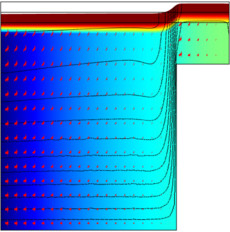
The Poroelasticity interface couples Darcy's law and solid mechanics to assess deformation of porous media that results from fluid withdrawals. The model builds on top of the Terzaghi Compaction example. Results from Terzaghi compaction and Biot poroelasticity analyses are compared to ... Read More
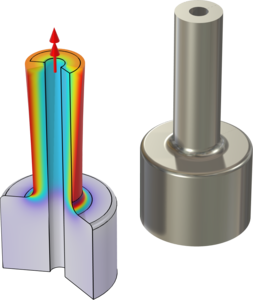
Including circumferential displacements in a 2D axisymmetric Solid Mechanics interface allows to compute twist and bending deformations. This model determines stress concentration factors for a hollow shaft for load cases of axial extension, torsion, as well as bending, using a ... Read More
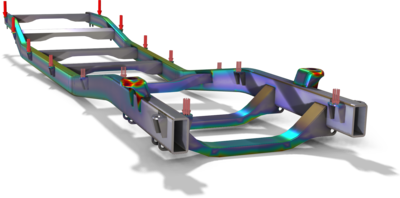
This example illustrates how to perform eigenfrequency and static analyses of a ladder frame structure for a light truck. Important modeling strategies are described. For example, how to convert a solid geometry to a shell model, how to make different types of connections, and how to ... Read More
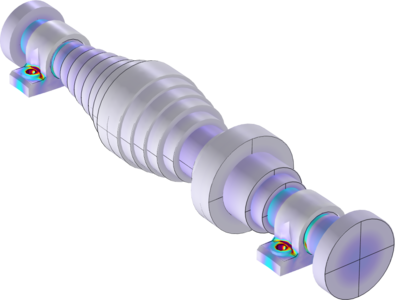
Hydrodynamic bearings generate heat due to the viscous losses in the lubricant. As a result, the temperature of the rotor increases causing deformation and thermal stresses in both the rotor and the bearing housing. This example shows how to model different physical phenomena that are ... Read More
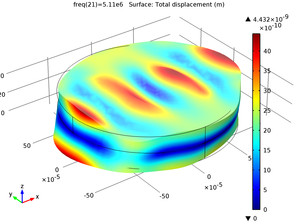
AT cut quartz crystals are widely employed in a range of applications, from oscillators to microbalances. One of the important properties of the AT cut is that the resonant frequency of the crystal is temperature independent to first order. This is desirable in both mass sensing and ... Read More
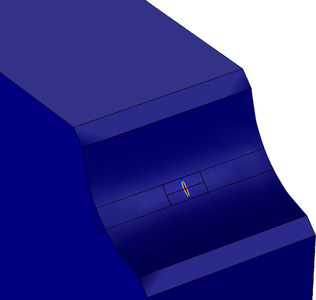
When a linear guide is loaded above the manufacturer's specification limit, one concern is whether the contact loads will introduce fatigue spalling. In this system analysis, the entire guide has been analyzed and the mostly damaging contact load has been identified to occur on a rail ... Read More
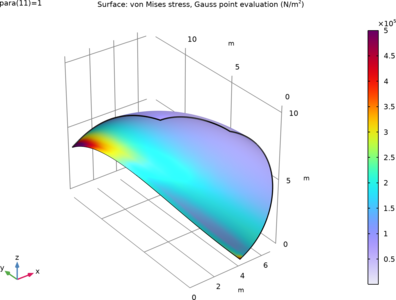
This example studies the deformation of a hemispherical shell, where the loads cause significant geometric nonlinearity. The maximum deflections are more than two magnitudes larger than the thickness of the shell. The problem is a standard benchmark, used for testing shell formulations ... Read More


