
The Application Gallery features COMSOL Multiphysics® tutorial and demo app files pertinent to the electrical, structural, acoustics, fluid, heat, and chemical disciplines. You can use these examples as a starting point for your own simulation work by downloading the tutorial model or demo app file and its accompanying instructions.
Search for tutorials and apps relevant to your area of expertise via the Quick Search feature. Note that many of the examples featured here can also be accessed via the Application Libraries that are built into the COMSOL Multiphysics® software and available from the File menu.
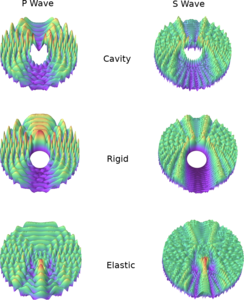
This model showcases how to solve for the scattered field when knowing the incident field for three different types of scatterer, that is, an infinitely rigid one, a cavity and an elastic inclusion. This formulation can be useful when the scatterer is in the far field of the source, so ... Read More
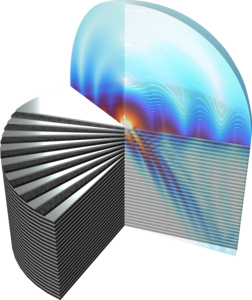
The modal dispersion in a metamaterial can be engineered by changing the type of material and dimension of the composing unit cells. For instance, a periodically organized subwavelength metal–dielectric layered metamaterial exhibits an anisotropic dispersion characteristic in the ... Read More

Frequency selective surfaces (FSS) are periodic structures with a bandpass or a bandstop frequency response. This model shows that only signals around the center frequency can pass through the periodic complementary split ring resonator layer. Read More
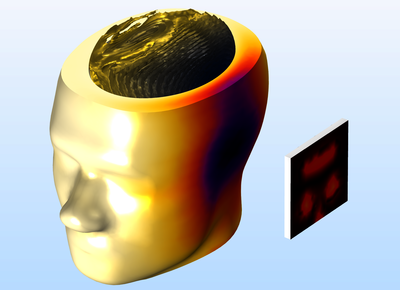
Users of consumer electronics with radiating devices are exposed to radio frequency (RF) emission. The amount of exposure is defined as the specific absorption rate (SAR). That is, the SAR value represents the radio frequency (RF) energy rate absorbed by a body. This model computes local ... Read More
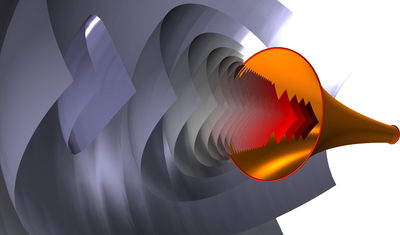
This tutorial shows how to include local nonlinear effects when simulating the acoustics of an exponential horn. Nonlinear effects become important when an acoustic horn is used for high amplitude signaling. The Nonlinear Acoustics (Westervelt) Contributions feature available for the ... Read More

The Ion Range Benchmark model simulates the passage of energetic protons through silicon with both ionization losses and nuclear scattering. The initial energy of the protons is varied using a parametric sweep from 1 keV to 100 MeV. The average path length of the protons is compared to ... Read More
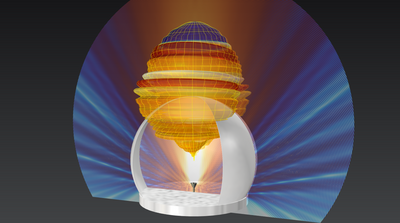
This model demonstrates an efficient approach to simulating a thin, spherical, large radome using a 2D axisymmetric formulation with cubic discretization. The axisymmetric method captures full 3D behavior for azimuthally symmetric geometries at only a fraction of the computational cost. ... Read More
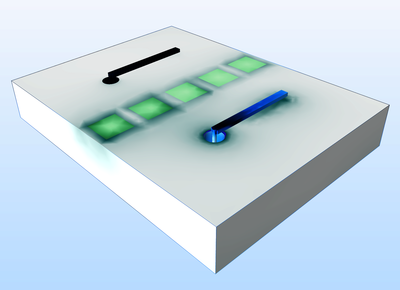
An Electromagnetic Band Gap (EBG) structure can be used to increase the isolation between antennas close to each other. The decoupling effect is not only a function of frequency but also polarization and coupling-plane configuration. When designing an EBG structure, one needs to make ... Read More
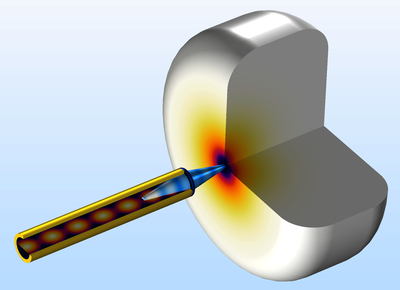
The response of a millimeter wave with frequencies of 35 GHz and 95 GHz is known to be very sensitive to water content. This model utilizes a low-power 35 GHz Ka-band millimeter wave and its reflectivity to moisture for noninvasive cancer diagnosis. Since skin tumors contain more ... Read More
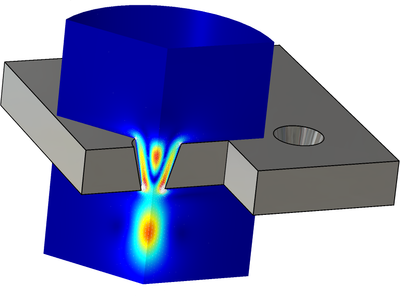
This model analyzes the nonlinear transfer impedance of a tapered orifice that can be part of a perforate or microperforated plate (MPP). The analysis is carried out for various degrees of tapering of the perforate and for a frequency range. A linear analysis is set up in the frequency ... Read More


