
The Application Gallery features COMSOL Multiphysics® tutorial and demo app files pertinent to the electrical, structural, acoustics, fluid, heat, and chemical disciplines. You can use these examples as a starting point for your own simulation work by downloading the tutorial model or demo app file and its accompanying instructions.
Search for tutorials and apps relevant to your area of expertise via the Quick Search feature. Note that many of the examples featured here can also be accessed via the Application Libraries that are built into the COMSOL Multiphysics® software and available from the File menu.
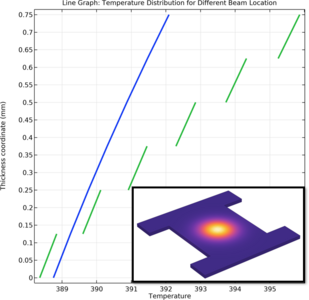
This example uses the thermal expansion of a laminated composite shell model to demonstrate the use of the feature Thermal Contact, Interface, applied on interfaces between layers in a laminated composite shell. The first study is computed neglecting this additional thermal resistance in ... Read More
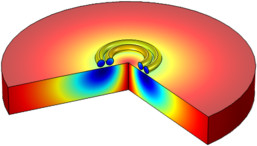
A time-varying current induces a time-varying magnetic field. The magnetic field induces currents in neighboring conductors. The induced currents are called eddy currents. In this model, the phenomenon is illustrated by a time-harmonic field simulation as well as a transient analysis, ... Read More
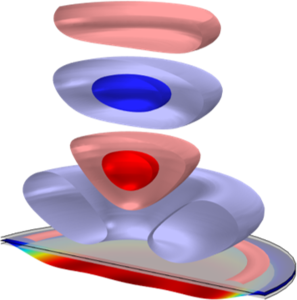
This tutorial demonstrates a full electro-vibroacoustic analysis of a conceptual electrostatic speaker driver, composed of thin conducting plastic diaphragm residing between two perforated metal sheets called grids or stators. When an audio signal is applied to the grids (out of phase), ... Read More

Micromirrors are used in certain MEMS devices to control optic elements. This example model illustrates a mirror that is initially actuated for a short time and then exhibits damped vibrations. It simulates a vibrating micromirror surrounded by air and uses the Thermoviscous Acoustics, ... Read More
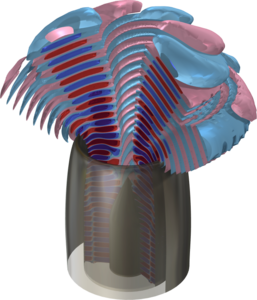
This model demonstrates two approaches to model the acoustics in a generic nacelle with an acoustic liner and a background flow. The first method uses the Compressible Potential Flow and the Linearized Potential Flow, Frequency Domain interfaces, while the second, more detailed approach, ... Read More
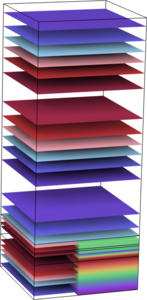
In applications where pressure waves and elastic waves propagate in porous materials filled with air both thermal and viscous losses are important. This is typically the case in insulation materials for room acoustics or lining materials in car cabins. Another example is porous materials ... Read More
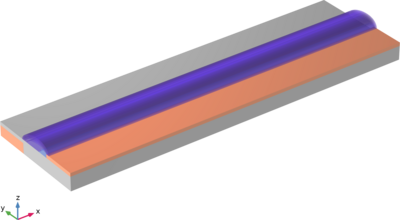
This model demonstrates the simulation of surface dielectric barrier discharges (DBDs) using the Electric Discharge interface. The formulation incorporates a comprehensive set of physical processes, including charge transport, impact ionization, electron attachment, recombination, and ... Read More
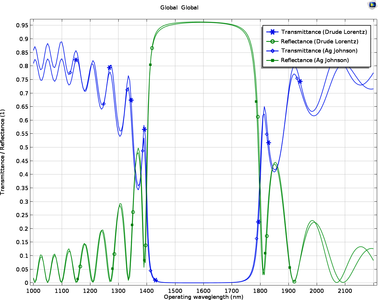
This example of a plasmonic waveguide filter shows that the waveguide rejects the electromagnetic radiation of the wavelength between 1.4 um and 1.6 um, but allows the rest of the wavelength. The silver material can be modeled using the Drude-Lorentz approximation, with ε∞ = 3.7, ωp = 13 ... Read More
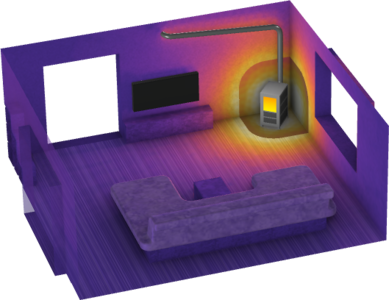
This model represents a stove in a living room. A radiation study is performed with the Surface-to-Surface Radiation physics interface. It shows the intensity of the stove radiation received on different surfaces of the room. Read More
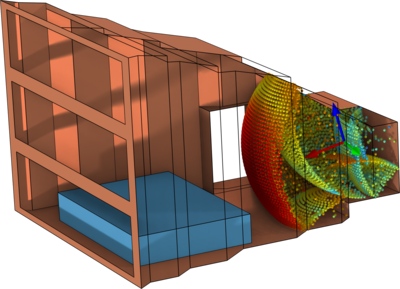
These models introduce how to perform convolution via the convolution integral, discrete convolution, and convolution theorem. Specifically, they show how to implement convolution by applying these methods to the low-pass filtering of a room impulse response (IR) and the auralization of ... Read More


