
The Application Gallery features COMSOL Multiphysics® tutorial and demo app files pertinent to the electrical, structural, acoustics, fluid, heat, and chemical disciplines. You can use these examples as a starting point for your own simulation work by downloading the tutorial model or demo app file and its accompanying instructions.
Search for tutorials and apps relevant to your area of expertise via the Quick Search feature. Note that many of the examples featured here can also be accessed via the Application Libraries that are built into the COMSOL Multiphysics® software and available from the File menu.
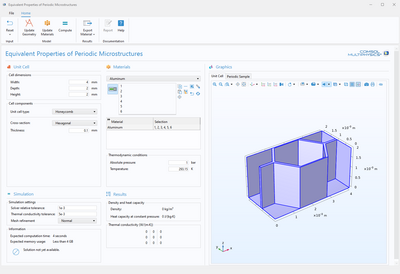
This app demonstrates the following: Visualization of a periodic structure from a unit cell Resetting some or all input parameters Export the resulting material properties as an MPH-file or an XML-file that can be imported to a COMSOL Multiphysics session Periodic microstructures are ... Read More
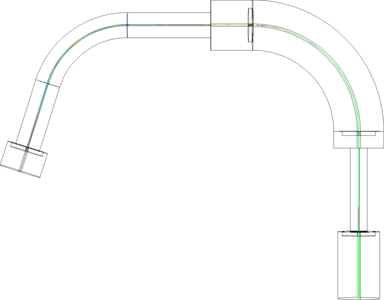
This tutorial utilizes the Particle Beam feature to examine the performance of a high-precision spectrometer. An ion beam is subjected to electric and magnetic forces, and only a fraction of the incoming beam is transmitted to the detector. The Particle Counter feature is used to compute ... Read More
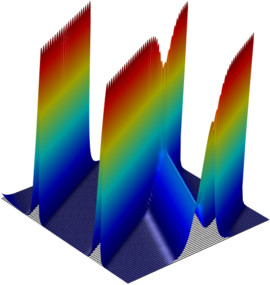
The Korteweg-de Vries (KdV) equation models water waves. It contrasts sharply to the Burgers equation, because it introduces no dissipation and the waves travel seemingly forever. Solitons have their primary practical application in optical fibers. Specifically, a fiber’s linear ... Read More
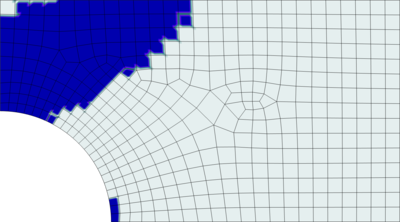
This example shows the analysis of a perforated plate loaded into the plastic regime. The purpose of the analysis is to demonstrate how plastic strains can be mapped between dissimilar meshes. Read More
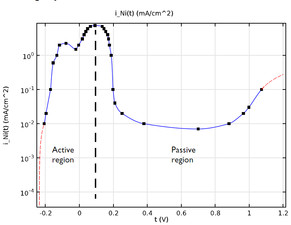
This model exemplifies the basic principles of crevice corrosion and how a time-dependent study can be used to simulate the electrode deformation. The model is in 2D and the polarization data for the corrosion reaction is taken from a paper by Absulsalam and others. The model and the ... Read More
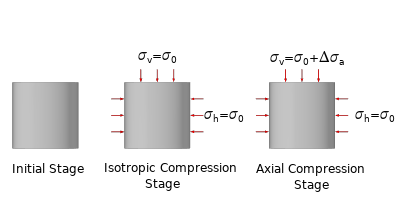
In this example, triaxial and oedometer tests are simulated using the Hardening Soil material model. Both tests exhibit a hyperbolic stress–strain relationship. For the triaxial test, it is confirmed that the axial stress approaches the analytical failure stress asymptotically. In the ... Read More
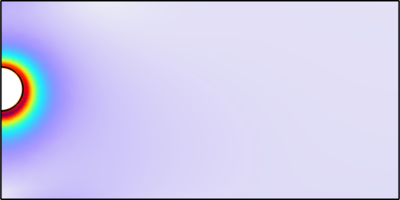
This example models the behavior of soil during a tunnel excavation. The surface settlement and the width of the plastic region around the tunnel are important parameters needed to predict required reinforcements during the excavation. Two study steps are used. The first study computes ... Read More
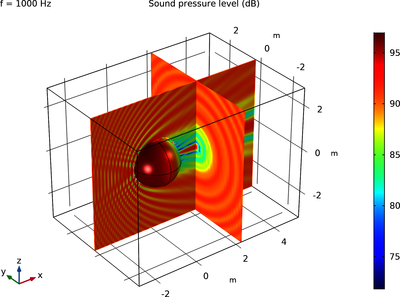
In this classical benchmark model, a spherical scatterer is placed in a plane wave background field. When the sphere is modeled as sound hard, the problem has an analytical solution. The model compares the results using the Pressure Acoustics, Boundary Elements interface with the ... Read More


