
The Application Gallery features COMSOL Multiphysics® tutorial and demo app files pertinent to the electrical, structural, acoustics, fluid, heat, and chemical disciplines. You can use these examples as a starting point for your own simulation work by downloading the tutorial model or demo app file and its accompanying instructions.
Search for tutorials and apps relevant to your area of expertise via the Quick Search feature. Note that many of the examples featured here can also be accessed via the Application Libraries that are built into the COMSOL Multiphysics® software and available from the File menu.
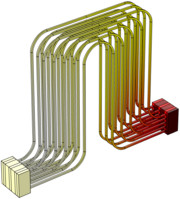
This model simulates a temperature profile in a number of cells and cooling fins in a liquid-cooled battery pack. The model solves in 3D and for an operational point during a load cycle. A full 1D electrochemical model for the lithium battery calculates the average heat source. Read More
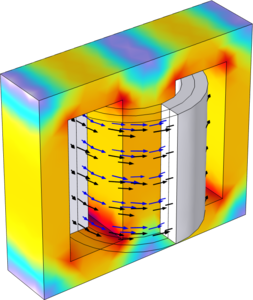
This is the transient model of a single phase E-core transformer using a homogenized approach for the multi-turn primary and secondary coils. The model includes the effect of magnetic saturation (B–H curve) in the core and shows how to connect the transformer model to the external ... Read More
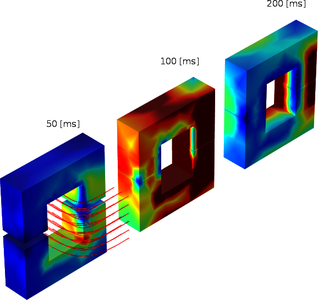
Electrical events, such as an overcurrent or overload, can seriously damage electrical circuits or power lines. To avoid expensive replacements of critical parts, electric switch circuit breakers can be installed. These mechanically interrupt the current flow or surge by moving a plunger ... Read More
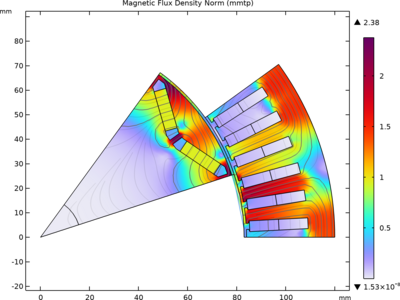
Obtaining the steady-state performance is an essential task for the electric motor designer. As with many electromagnetic devices, the steady-state condition of an electric motor is when electric and magnetic field variations have stabilized to periodic variations. That is when ... Read More
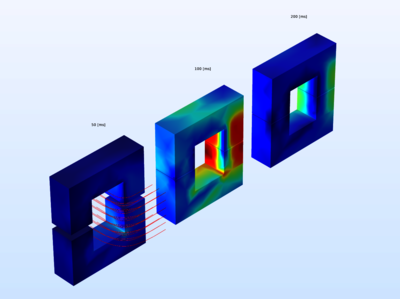
Electrical events, such as an overcurrent or overload, can seriously damage electrical circuits or power lines. To avoid expensive replacements of critical parts, electric switch circuit breakers can be installed. These mechanically interrupt the current flow or surge by moving a plunger ... Read More
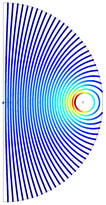
The mutual inductance between a primary and secondary single turn coil in a concentric coplanar arrangement is computed using a DC, steady-state, model and compared against the analytic solution. The induced currents in the secondary coil are computed using an AC, frequency-domain, ... Read More
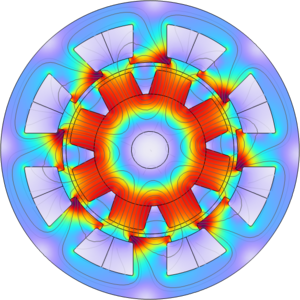
In this model, a rotor with permanent magnets and a nonlinear magnetic material rotates within a stator of the same magnetic material. The generated voltage in windings around the stator is calculated as a function of time. COMSOL Multiphysics models the rotation with assemblies and ... Read More
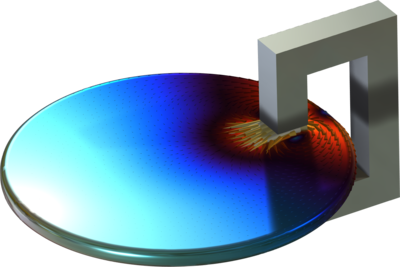
A magnetic brake consists of a permanent magnet, which induces currents in a rotating copper disk. The resulting eddy currents interact with the magnetic flux to produce Lorentz forces and subsequently a braking torque. This 3D problem is solved using a stationary formulation for the ... Read More
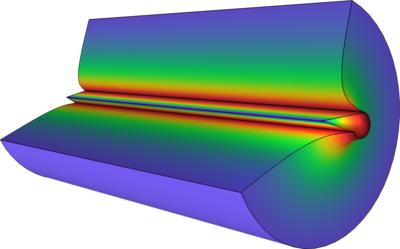
This introduction model creates a simple model of the magnetostatics problem with a wire of infinite length carrying current, which is commonly found in textbooks. Since there is an analytical solution to this problem, the model can be used to compare theory with numerical results from ... Read More
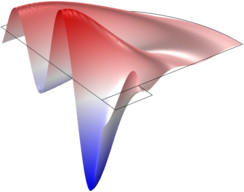
A piezoelectric transducer can be used either to transform an electric current to an acoustic pressure field or, the opposite, to produce an electric current from an acoustic field. These devices are generally useful for applications that require the generation of sound in air and ... Read More


