
The Application Gallery features COMSOL Multiphysics® tutorial and demo app files pertinent to the electrical, structural, acoustics, fluid, heat, and chemical disciplines. You can use these examples as a starting point for your own simulation work by downloading the tutorial model or demo app file and its accompanying instructions.
Search for tutorials and apps relevant to your area of expertise via the Quick Search feature. Note that many of the examples featured here can also be accessed via the Application Libraries that are built into the COMSOL Multiphysics® software and available from the File menu.
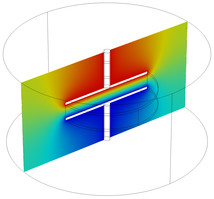
A capacitor with an applied sinusoidally time-varying voltage difference is modeled. A wide frequency range is considered and the impedance of the device is computed. Solver accuracy is addressed. The relationship between the frequency domain impedance and the steady-state capacitance ... Read More
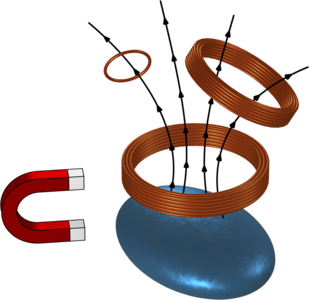
Differential inductance is relevant when a low-frequency electromagnetic system includes magnets, nonlinear magnetic materials, and moving parts. These models present examples of computing the differential inductance and using these within simplified lumped models. To learn more about ... Read More

Unwanted electrical arcing poses significant risks to the reliability and safety of electrical and electronic systems. To enhance predictive capabilities and deepen understanding of arc behavior, we present a comprehensive numerical model for simulating transient arc discharge phenomena ... Read More

This tutorial model demonstrates how to use the Combined Inductively/DC Discharge interface to simulate the plasma generated in a pulsed arc. This modeling technique is useful for a large range of industrial applications including cutting, welding, spraying, waste destruction, and ... Read More
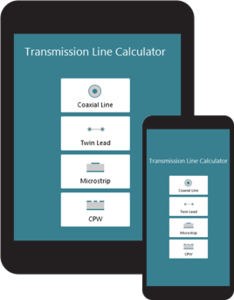
This app demonstrates the following: Creating apps for small screens such as smartphones User-interface navigation with a top menu typically used on websites Dynamically hiding forms using card stacks to minimize the space required by the app Changing appearance by using different ... Read More
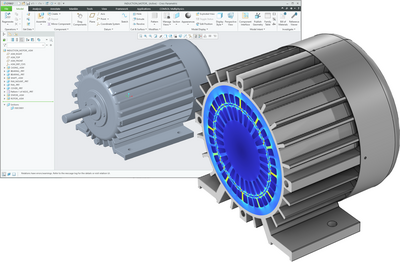
This model illustrates how to compute the torque of a three-phase squirrel-cage induction motor at various speeds. In the example the torque is computed by averaging the results from simulations performed on 2D cross sections at several locations along the induction motor. The 3D ... Read More
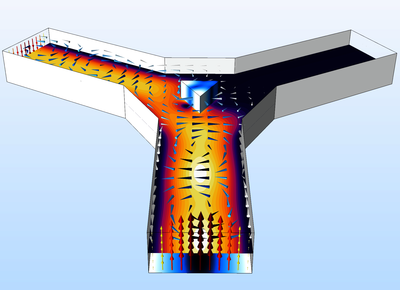
A lossy ferrite circulator at 3GHz is modeled. Geometrical design parameters are varied to match the impedance for minimal reflection of the fundamental TE10 rectangular waveguide mode. Read More
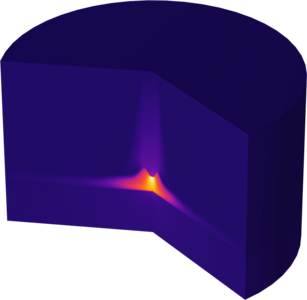
This example investigates the electrical and thermal characteristics of a welding argon arc created in a point-to-plane configuration. The discharge is assumed to be in local thermodynamic equilibrium. The electric arc is considered a conductive fluid medium and is modeled using a ... Read More
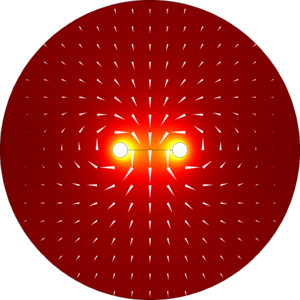
A parallel wire transmission line is composed of two conducting wires in a dielectric such as air. The fields around such a transmission line are not directly confined by the conductors, and extend to infinity, although they drop off in rapidly away from the wires. This model ... Read More
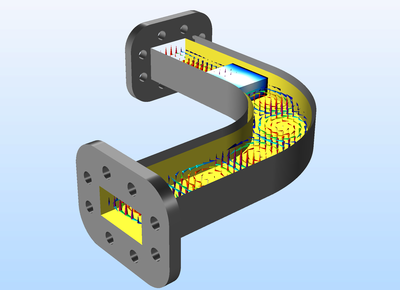
This is a model of an RF waveguide bend with a dielectric block inside. There are electromagnetic losses in the block as well as on the waveguide walls which cause the assembly to heat up over time. The material properties of the block are functions of temperature. The transient thermal ... Read More


