
The Application Gallery features COMSOL Multiphysics® tutorial and demo app files pertinent to the electrical, structural, acoustics, fluid, heat, and chemical disciplines. You can use these examples as a starting point for your own simulation work by downloading the tutorial model or demo app file and its accompanying instructions.
Search for tutorials and apps relevant to your area of expertise via the Quick Search feature. Note that many of the examples featured here can also be accessed via the Application Libraries that are built into the COMSOL Multiphysics® software and available from the File menu.
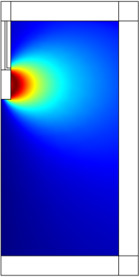
This model presents a 2D axisymmetric dipolar microwave plasma source sustained through resonant heating of the electrons. This is known as electron cyclotron resonance (ECR), which occurs when a suitable high magnetic flux density is present along with the microwaves. This is an ... Read More
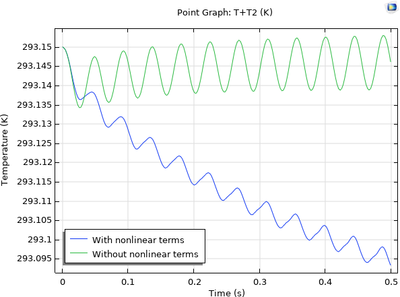
A thermoacoustic engine is a device with no moving parts that can generate acoustic energy from temperature gradients within the engine. It uses the relationship between the movement of oscillating air and the temperature changes in the air compressed and expanded by the acoustic waves. ... Read More
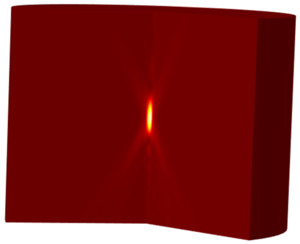
This tutorial shows how to model tissue heating induced by focused ultrasound. First, the stationary acoustic field in the water and the tissue are modeled to obtain the acoustic intensity distribution in the tissue. The absorbed acoustic energy is then calculated and used as the heat ... Read More
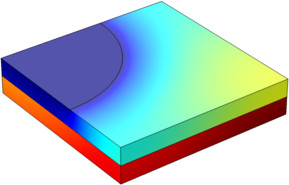
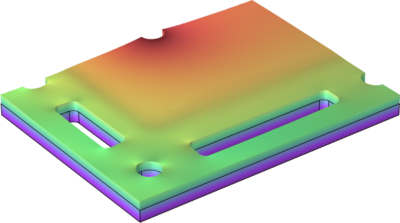
In modeling of transport by diffusion or conduction in thin layers, we often encounter large differences in dimensions of the different domains in a model. If the modeled structure is a so-called sandwich structure, we can replace the thinnest geometrical layers with a thin layer ... Read More
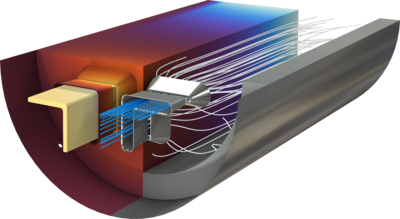
In massive forming processes like rolling or extrusion, metal alloys are deformed in a hot solid state with material flowing under ideally plastic conditions. Such processes can be simulated effectively using computational fluid dynamics, where the material is considered as a fluid with ... Read More
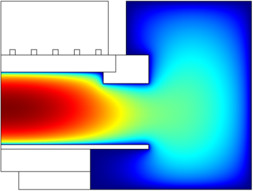
The GEC cell was introduced by NIST in order to provide a standardized platform for experimental and modeling studies of discharges in different laboratories. The plasma is sustained via inductive heating. The Reference Cell operates as an inductively-coupled plasma in this model. This ... Read More
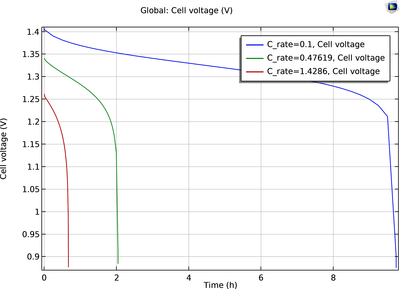
This model reproduces the NiCd battery model and the results presented in De Vidts' and White's paper from 1995. Ref: P. De Vidts, R. E. White, “Mathematical Modeling of a Nickel-Cadmium Cell: Proton Diffusion in the Nickel Electrode”, J. Electrochem. Soc, Vol. 142, No. 5, May 1995. Read More
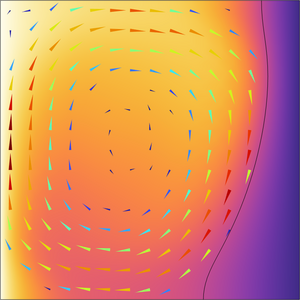
This example demonstrates how to model phase transition by a moving boundary interface according to the Stefan problem. A square cavity containing both solid and liquid tin is submitted to a temperature difference between left and right boundaries. Fluid and solid parts are solved in ... Read More
A fuel cell stack operates at temperatures just below 100 °C, which means that it has to be heated at start-up. The fuel cell stack consists of unit cell of anode, membrane, and cathode connected in series through bipolar plates. This study presents a model that couples the thermal and ... Read More
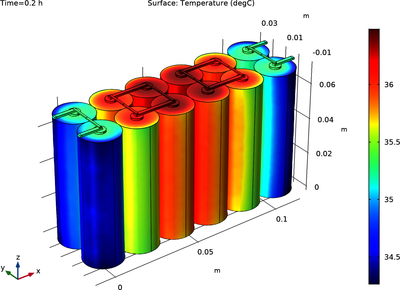
This example demonstrates how to model the temperature distribution in a battery pack during a 4C discharge. The pack is constructed by first coupling two cylindrical batteries in parallel. Six parallel-connected pairs are then connected in series to create the full pack. (This is also ... Read More