
The Application Gallery features COMSOL Multiphysics® tutorial and demo app files pertinent to the electrical, structural, acoustics, fluid, heat, and chemical disciplines. You can use these examples as a starting point for your own simulation work by downloading the tutorial model or demo app file and its accompanying instructions.
Search for tutorials and apps relevant to your area of expertise via the Quick Search feature. Note that many of the examples featured here can also be accessed via the Application Libraries that are built into the COMSOL Multiphysics® software and available from the File menu.
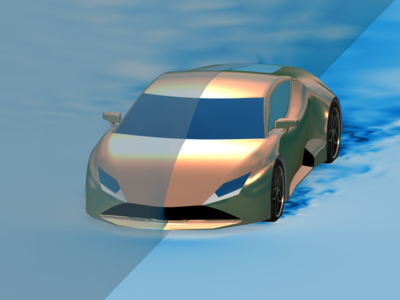
This example simulates turbulent flow around a sports car traveling at a speed of 180 km/h using Large Eddy Simulations (LES). Read More
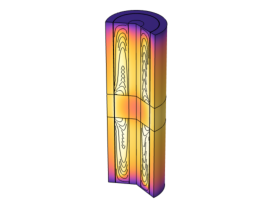
Fluid dampers are used in military devices for shock isolation and in civil structures for suppressing earthquake-induced shaking and wind-induced vibrations, among many other applications. Fluid dampers work by dissipating the mechanical energy into heat. This model shows the phenomenon ... Read More
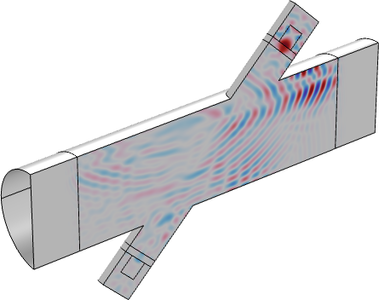
Ultrasonic flowmeters determine the velocity of a fluid flowing through a pipe by sending an ultrasonic signal across the flow at a skew angle. When there is no flow, the transmitting time between the transmitter and the receiver is the same for the signals sent in the upstream and ... Read More
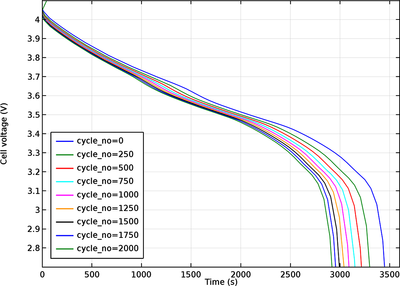
Side reactions and degradation processes may lead to a number of undesirable effects, causing capacity loss in lithium-ion batteries. Typically, aging occurs due to multiple complex phenomena and reactions that occur simultaneously at different places in the battery, and the degradation ... Read More
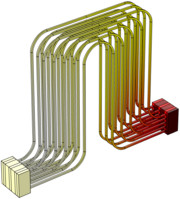
This model simulates a temperature profile in a number of cells and cooling fins in a liquid-cooled battery pack. The model solves in 3D and for an operational point during a load cycle. A full 1D electrochemical model for the lithium battery calculates the average heat source. Read More
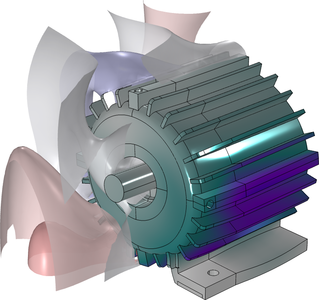
This model analyses the noise generated by an electric motor during its operation at different speeds of rotation. The type of electric motor analyzed, a permanent magnet synchronous motor (PMSM) uses permanent magnets in the rotor and a variable frequency current traveling through the ... Read More
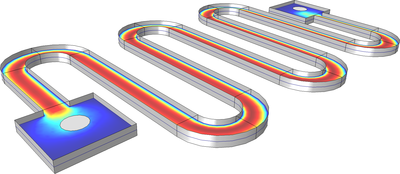
Removing halogen groups from hydrocarbons is an important reaction step in several chemical processes. One application is water purification. Other examples involve organic synthesis, where the removal of halogen groups serves as a starting point for carbon-carbon coupling reactions. ... Read More
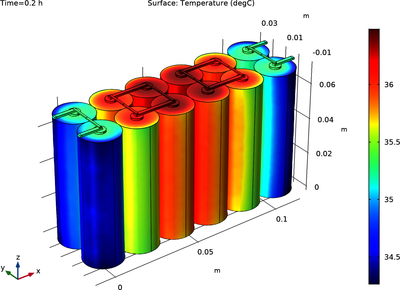
This example demonstrates how to model the temperature distribution in a battery pack during a 4C discharge. The pack is constructed by first coupling two cylindrical batteries in parallel. Six parallel-connected pairs are then connected in series to create the full pack. (This is also ... Read More
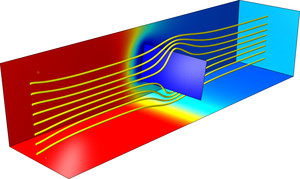
Chemical vapor deposition (CVD) allows a thin film to be grown on a substrate through molecules and molecular fragments adsorbing and reacting on a surface. This example illustrates the modeling of such a CVD reactor where triethyl-gallium first decomposes, and the reaction products ... Read More
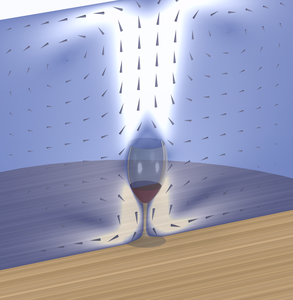
During professional wine tasting, several samples of wine are judged in one session. It is important that each sample is covered, since evaporation of ethanol and water will change the taste. This model simulates the evaporation of ethanol and water from a wine glass. Evaporation of ... Read More


