
The Application Gallery features COMSOL Multiphysics® tutorial and demo app files pertinent to the electrical, structural, acoustics, fluid, heat, and chemical disciplines. You can use these examples as a starting point for your own simulation work by downloading the tutorial model or demo app file and its accompanying instructions.
Search for tutorials and apps relevant to your area of expertise via the Quick Search feature. Note that many of the examples featured here can also be accessed via the Application Libraries that are built into the COMSOL Multiphysics® software and available from the File menu.
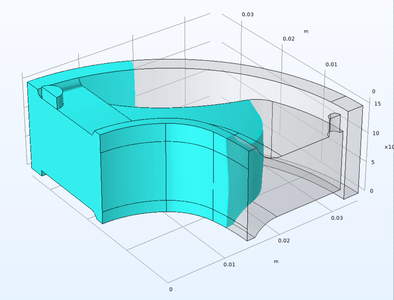
This tutorial shows how to set up a 3D simulation of rubber injection molding. A phase field method is used to track the interface between the rubber and the displaced air. The rubber is modeled as shear-thinning inelastic non-Newtonian power law fluid with a fluid-consistency ... Read More
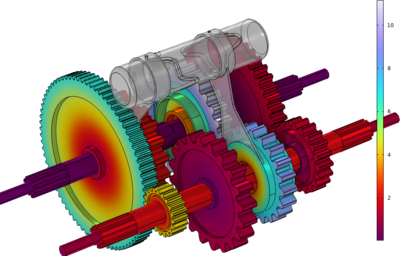
This example illustrates the modeling of a sequential manual transmission, where the gears are selected sequentially with the help of a rotating drum. The shift drum has two grooves of specific profile carved around the circumference. As the drum rotates, the grooves on the drum guide a ... Read More

The first part of the application computes the modes for a straight step index fiber made of silica glass. In the second part, a step index fiber bend with a 3 mm radius of curvature is analyzed with respect to propagating modes and radiation loss. It is shown how to find the power ... Read More
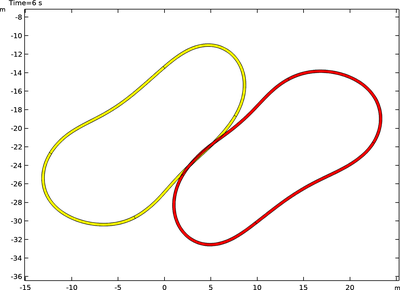
In this conceptual example, the soft impact between two elastic rings is modeled using the Solid Mechanics interface. One of the rings is given an initial velocity to initiate the impact event. Both rings are unconstrained and not subjected to any external forces. Contact is modeled ... Read More
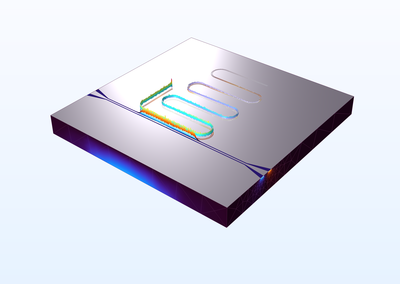
Developments in the last decade have made circuit quantum electrodynamics (cQED) the leading architecture for quantum computation. cQED is the solid-state version of cavity QED, which studies the basic light-matter interactions at the quantum level. This model examines one of the main ... Read More
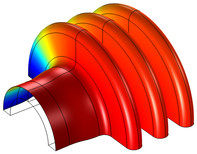
A cooling flange in a chemical process is used to cool the process fluid, which flows through the flange. The surrounding air cools the flange via natural convection. In the stationary model, the forced convection to the process fluid is modeled using a constant heat transfer ... Read More
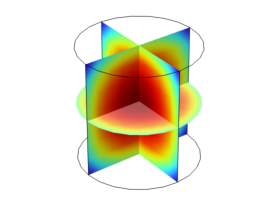
These models use the Discrete Ordinates method (DOM) and P1 approximation to solve a 3D radiative transfer problem in an emitting, absorbing, and linear-anisotropic scattering finite cylindrical medium. Using the S6 quadrature of DOM leads to accurate results, which are needed in ... Read More
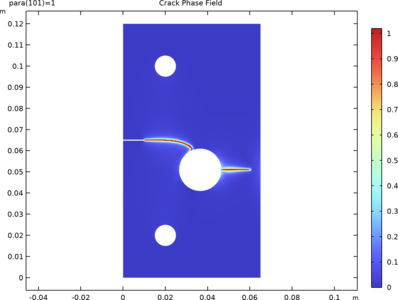
In this example, the brittle fracture of a holed plate with a notch is modeled using a phase-field damage model. The geometry of the plate is set up so that a mixed-mode fracture is induced, with dimensions and material properties taken from experimental data. The example shows how to ... Read More

A plane TE-polarized electromagnetic wave is incident on a gold nanoparticle on a dielectric substrate. The absorption and scattering cross-sections of the particle are computed for a few different polar and azimuthal angles of incidence. The model first computes a background field from ... Read More
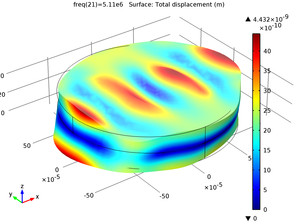
AT cut quartz crystals are widely employed in a range of applications, from oscillators to microbalances. One of the important properties of the AT cut is that the resonant frequency of the crystal is temperature independent to first order. This is desirable in both mass sensing and ... Read More