
The Application Gallery features COMSOL Multiphysics® tutorial and demo app files pertinent to the electrical, structural, acoustics, fluid, heat, and chemical disciplines. You can use these examples as a starting point for your own simulation work by downloading the tutorial model or demo app file and its accompanying instructions.
Search for tutorials and apps relevant to your area of expertise via the Quick Search feature. Note that many of the examples featured here can also be accessed via the Application Libraries that are built into the COMSOL Multiphysics® software and available from the File menu.
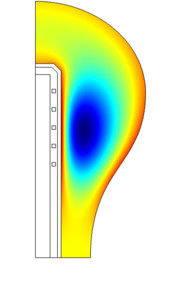
This model simulates an electrodeless lamp with argon/mercury chemistry. The low excitation threshold for mercury atoms means that even though the mercury is present in small concentrations, its behavior dominates. There is strong UV emission from the plasma at 185 nm and 253 nm. The UV ... Read More
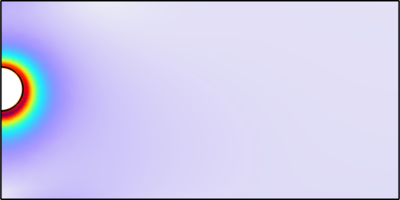
This example models the behavior of soil during a tunnel excavation. The surface settlement and the width of the plastic region around the tunnel are important parameters needed to predict required reinforcements during the excavation. Two study steps are used. The first study computes ... Read More
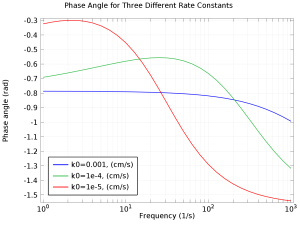
The purpose of this app is to understand EIS, Nyquist, and Bode plots. The app lets you vary the bulk concentration, diffusion coefficient, exchange current density, double layer capacitance, and the maximum and minimum frequency. Electrochemical impedance spectroscopy (EIS) is a common ... Read More
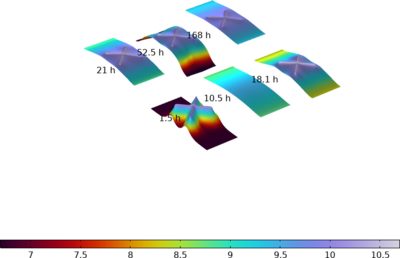
An established method for benchmarking the atmospheric corrosion resistance of materials is the use of accelerated corrosion tests (ACT) performed in climate chambers. The main purpose of the ACTs is to make reliable and fast predictions of the long time behavior. The tests expose ... Read More
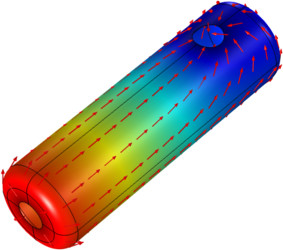
A goal for many applications is to predict physics in thin structures, such as shells, without modeling the thickness of the structure. This is because large aspect ratios can cause meshing and geometry analysis problems. This model demonstrates how to use the tangential derivative ... Read More
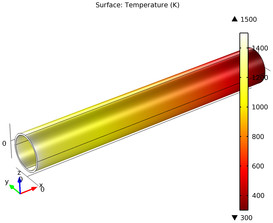
The heat distribution in a hollow pipe, whose ends are held at two different temperatures, is studied. The outside surface is assumed to be thermally isolated and the inner surfaces have radiation boundary conditions. The role of convection in the heat transfer is taken to be ... Read More

This model studies the heat conduction in a building structure separating two floors from the external environment. Four materials with distinct thermal conductivities k compose the structure. The exterior and interior boundaries are facing environments respectively at 0°C and 20°C. The ... Read More
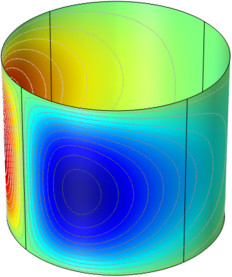
Journal bearings are used to carry radial loads, for example, to support a rotating shaft. A simple journal bearing consists of two rigid cylinders. The outer cylinder (bearing) wraps the inner rotating journal (shaft). The new thin-film flow user interfaces of the CFD Module enables ... Read More
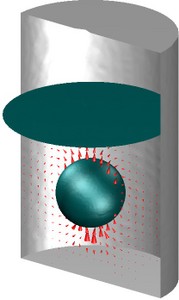
The level set method is well suited for problems with moving boundaries in which the geometry’s topology changes with time. A bubble of oil that travels up through water and finally merges with oil at the top causes this kind of topology change. For problems where the topology is ... Read More
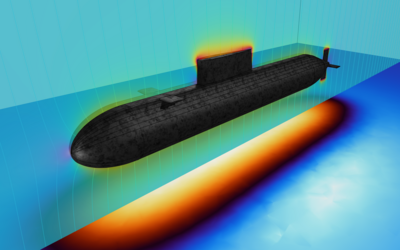
A vessel traveling on the surface or under water gives rise to detectable local disturbances in the Earth’s magnetic field. These disturbances can be used to trigger weapon systems. The magnetic signature of a ship can be reduced by generating a counteracting magnetic field of suitable ... Read More