
The Application Gallery features COMSOL Multiphysics® tutorial and demo app files pertinent to the electrical, structural, acoustics, fluid, heat, and chemical disciplines. You can use these examples as a starting point for your own simulation work by downloading the tutorial model or demo app file and its accompanying instructions.
Search for tutorials and apps relevant to your area of expertise via the Quick Search feature. Note that many of the examples featured here can also be accessed via the Application Libraries that are built into the COMSOL Multiphysics® software and available from the File menu.
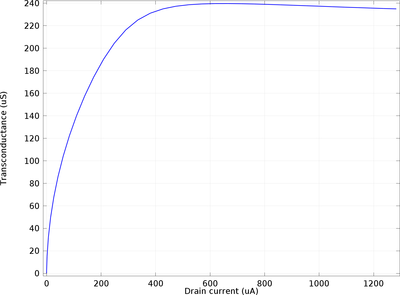
This model shows how to compute the AC characteristics of a MOSFET. Both the output conductance and the transconductance are computed as a function of the drain current. Read More
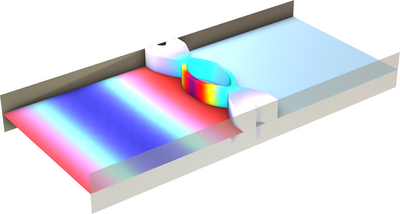
This model demonstrates topology optimization for a problem involving acoustic-structure interaction for a sound partition problem. The objective being to reduce sound transmission for a fixed solid material fraction. The design domain is modeled with a mixed formulation using the Solid ... Read More
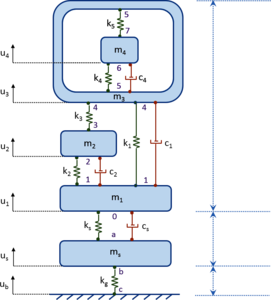
Several mass–spring–damper models have been developed to study the response of a human body where mass, spring, and damper elements represent mass of different body parts, stiffness, and damping properties of various tissues. In this example, a lumped model of a human body having five ... Read More
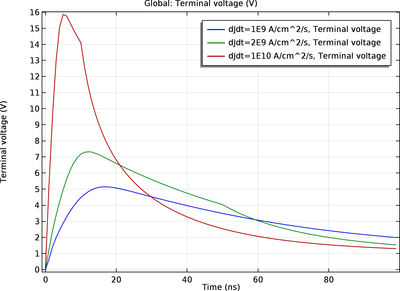
This tutorial simulates the turn-on transient (forward recovery) of a simple PIN diode, based on the book "Fundamentals of Power Semiconductor Devices" by B. J. Baliga (p. 242, 2008 edition). The diode is current driven with a constant ramp rate of 1e9, 2e9 and 1e10 A/cm^2/sec and a ... Read More
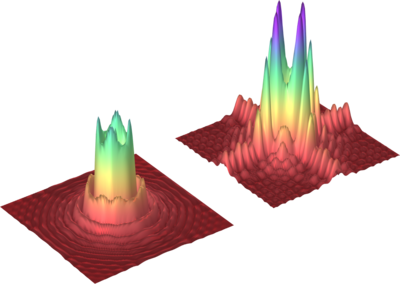
This example presents transient analysis of the wave propagation in rock mass caused by a short duration load on the surface. Such loads are typical during tunnel constructions and other excavations using blasting. The example shows the use of the Low-reflecting boundary conditions to ... Read More
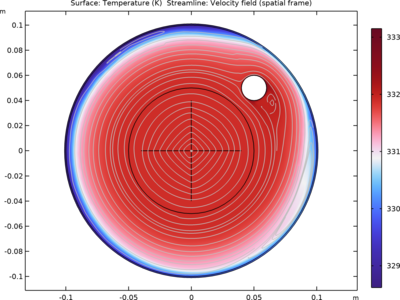
This model illustrates the modeling of temperature distribution in a simplified mixer. Read More
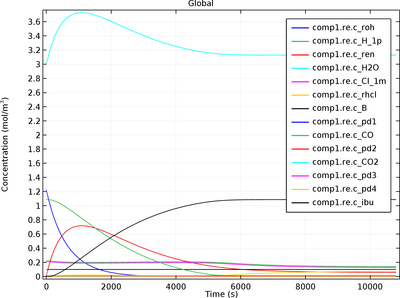
Kinetic analysis of catalytic reactions is essential for understanding rate behavior as well as the reaction mechanism. Developing knowledge of intrinsic reaction kinetics and of rate equations is central to reaction engineering studies aimed at improving reactor design. This model ... Read More
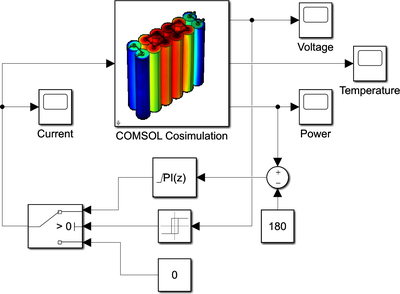
This model computes the temperature distribution in a battery pack that is in use at a specified power. The current is controlled in Simulink® to ensure constant power during usage. Read More


