
The Application Gallery features COMSOL Multiphysics® tutorial and demo app files pertinent to the electrical, structural, acoustics, fluid, heat, and chemical disciplines. You can use these examples as a starting point for your own simulation work by downloading the tutorial model or demo app file and its accompanying instructions.
Search for tutorials and apps relevant to your area of expertise via the Quick Search feature. Note that many of the examples featured here can also be accessed via the Application Libraries that are built into the COMSOL Multiphysics® software and available from the File menu.

This model demonstrates the transport of grains using a screw conveyor. The grains enter the conveyor through a chute and are transported over an incline by a rotating screw. This model also demonstrates how to build and run a model method that evaluates the mass flow rate. Read More
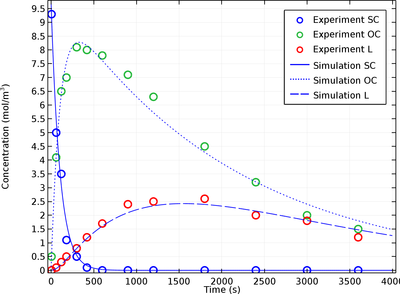
Biotechnology is a rapidly growing area in the pharmaceutical sciences. One example of a clinical application is gene therapy, where it is possible to produce proteins in vivo, using the body’s own mechanisms for protein production. Major issues in gene delivery involve the transport of ... Read More
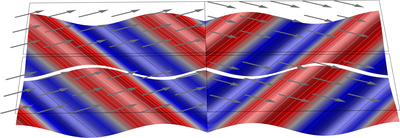
It is possible to engineer the structure of materials such that both the permittivity and permeability are negative. Such materials are realized by engineering a periodic structure with features comparable in scale to the wavelength. It is possible to model both the individual unit cells ... Read More
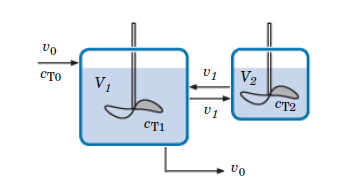
Real reactors can be modeled as combinations of ideal reactors. In this example the so-called "Dead zone model" is utilized. Two ideal CSTRs with interchange are set up to model the real reactor. One CSTR represents the highly agitated region and the other the less agitated region. For ... Read More

This model presents the flow noise generated by flow past the so-called tandem cylinder configuration. The test is part of the “First Workshop on Benchmark problems for Airframe Noise Computations”. The tutorial model shows the steps involved in a flow-induced noise simulation in COMSOL ... Read More
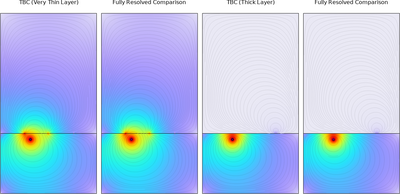
In electromagnetic simulations, such as transformers and converter stations, one often needs to include geometrically thin conductive layers. Explicitly meshing these thin layers can be computationally expensive and numerically challenging, especially when the layer thickness is much ... Read More
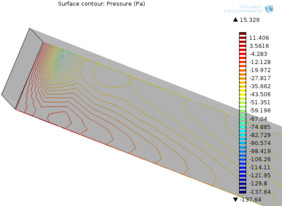
A lab-on-a-chip platform can be realized on a rotating disc by designing channels and other features to use the Coriolis or centrifugal forces to manipulate the flow. These forces are controlled by changing the angular velocity of the disc, so the platform is programmed by using a ... Read More
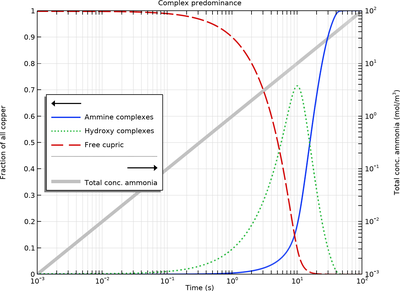
Cupric ions show a strong affinity to ammonia in aqueous solutions, forming strongly colored deep blue complexes. The relative amounts of the different ammine ligand complexes, with varying coordination numbers, are governed by the stability constants of the equilibria forming the ... Read More


