
The Application Gallery features COMSOL Multiphysics® tutorial and demo app files pertinent to the electrical, structural, acoustics, fluid, heat, and chemical disciplines. You can use these examples as a starting point for your own simulation work by downloading the tutorial model or demo app file and its accompanying instructions.
Search for tutorials and apps relevant to your area of expertise via the Quick Search feature. Note that many of the examples featured here can also be accessed via the Application Libraries that are built into the COMSOL Multiphysics® software and available from the File menu.
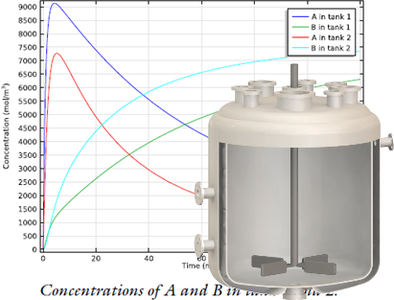
In the chemical and biochemical industries, for instance in fermentation processes, reactors having well-mixed conditions and liquid level control are common. This example shows modeling of a 0D ideal system of tank reactors in series with controlled feed inlet and product outlet ... Read More

The propagation of elastic waves in the ground after a seismic event is simulated using a 2D model. The effect of the ground surface topology on the wave propagation is illustrated when an ideal half-space is modified with the presence of a small mountain. The model is a variation of ... Read More
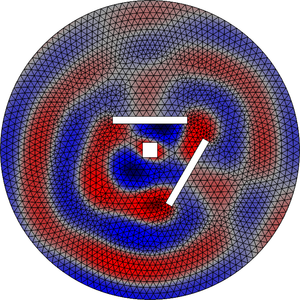
This simple tutorial model shows how to set up a parametric sweep over a number of frequency bands (octaves or 1/3 octaves) and remesh once per band. A frequency sweep is performed within each band, which now has an adequate mesh resolution. This approach saves some computational effort ... Read More
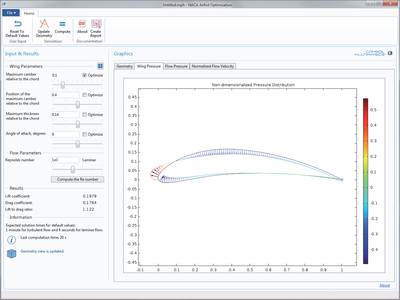
The aerodynamic properties of a wing, propeller, or turbine blade are to a large extent determined by the precise shape of the airfoil that is used. The NACA Airfoil Optimization application computes the two main aerodynamic properties (the lift and drag coefficients) of a fully ... Read More
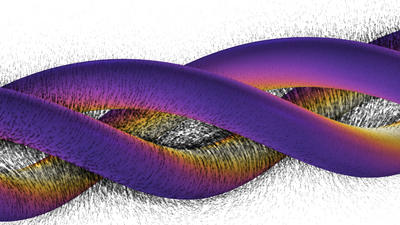
These models demonstrate various ways of exciting magnetic fields using the Magnetic Field Formulation interface in the AC/DC Module, an add-on to the COMSOL Multiphysics® software. To learn more about these models, see the accompanying blog post “Modeling of Excitations with ... Read More
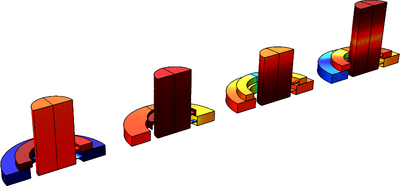
In this tutorial the geometry of an occluded ear-canal simulator is optimized to match the acoustic response of a given ear. The target data in this model stems from a simulation of an ear canal, but it can also be based on measurements, or a response specified by a standard. Read More
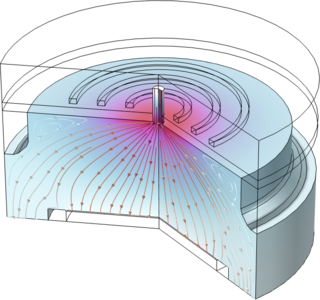
This tutorial studies the deposition of amorphous silicon using an inductively coupled plasma reactor with a silane/argon gas mixture. It examines how the deposition rate varies across the wafer as a function of silane mole fraction and input power. Read More
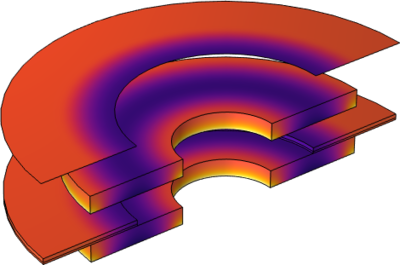
This tutorial model demonstrates the use of the multiphysics coupling feature Thermal Connection, Layered Shell, Surfaces. In this model, one layered shell is connected to heat domains by a facing boundary. The results obtained with the Heat Transfer in Shells interface are compared with ... Read More


