
The Application Gallery features COMSOL Multiphysics® tutorial and demo app files pertinent to the electrical, structural, acoustics, fluid, heat, and chemical disciplines. You can use these examples as a starting point for your own simulation work by downloading the tutorial model or demo app file and its accompanying instructions.
Search for tutorials and apps relevant to your area of expertise via the Quick Search feature. Note that many of the examples featured here can also be accessed via the Application Libraries that are built into the COMSOL Multiphysics® software and available from the File menu.
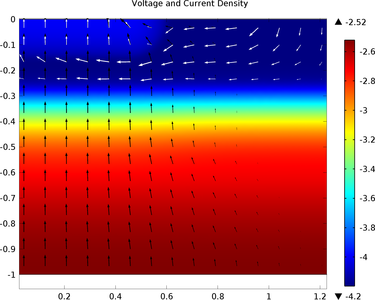
This model shows how to set up a simple Bipolar Transistor model. The output current-voltage characteristics in the common-emitter configuration are computed and the common-emitter current gain is determined. Read More
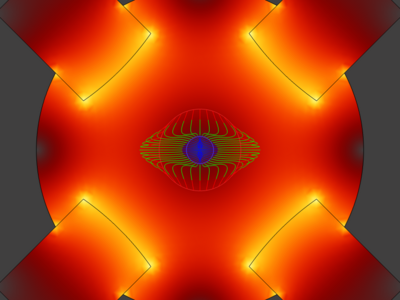
Just like optical lenses focus light, electric and magnetic lenses can be used for focusing beams of charged particles. This COMSOL Multiphysics model shows the path of B5+ ions passing through a focusing system of three magnetic quadrupoles. Each of the quadropoles focus the beam of ... Read More

This example describes an array of heating tubes submerged in a vessel with fluid flow entering at the bottom. This is a multiphysics model because it involves fluid dynamics coupled with heat transfer. The pressure and the velocity field are the solution of the Navier-Stokes equations, ... Read More
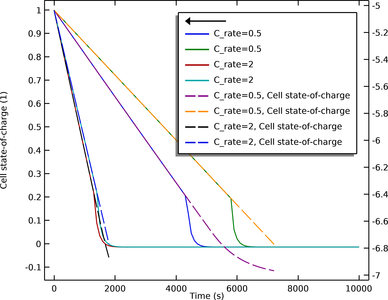
This tutorial demonstrates how to integrate multiple Lumped Battery models into the Electrical Circuit interface. Two batteries are connected in series. Each battery is protected by a shunt resistances that is activated if the battery state-of-charge reaches below a certain threshold ... Read More
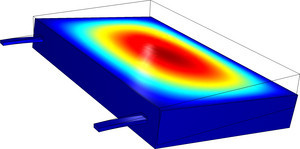
Squeezed-film gas damping is a critical aspect of many MEMS transducers and actuators. In accelerometers, for example, inertia produces a motion that the device detects. A typical structure connects a large proof mass to surrounding structures with elastic beams, which forms a mechanical ... Read More
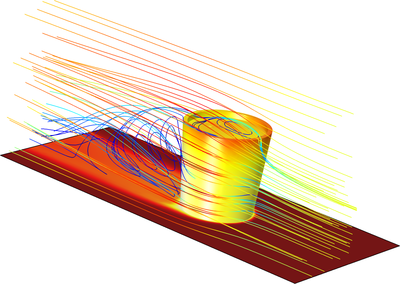
This tutorial shows how to couple three physics interfaces to model evaporative cooling. The effects that need to be taken into account are heat transfer, transport of water vapor, and fluid flow. The Wet Surface feature is used to implement the source term for the water vapor and to ... Read More
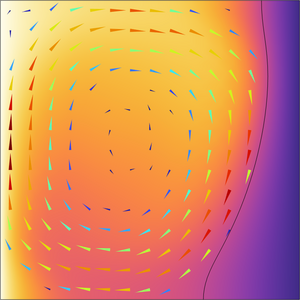
This example demonstrates how to model phase transition by a moving boundary interface according to the Stefan problem. A square cavity containing both solid and liquid tin is submitted to a temperature difference between left and right boundaries. Fluid and solid parts are solved in ... Read More
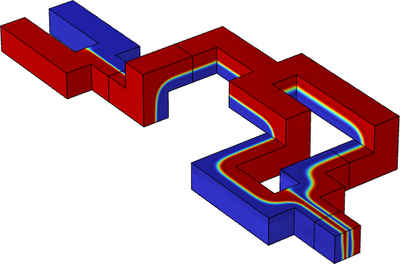
This example models a split-and-recombine mixer channel in which a tracer fluid is introduced and mixed by multilamination. Diffusion is removed from the model using an extremely low diffusion coefficient so that any numerical diffusion can be studied in the lamination interfaces. The ... Read More
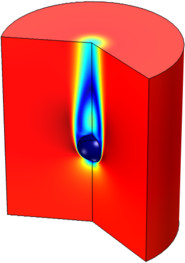
The first stop for polluted water entering a water work is normally a large tank, where large particles are left to settle. Generally, gravity settling is an economical method of separating particles. If the fluid in the tank is moving at a controlled low velocity, the particles can be ... Read More

Double-pipe heat exchangers, with their typical U-turn shape, are one of the simplest and cheapest type of heat exchangers used in the chemical process industry. This example studies the cooling of hot oil (130°C) by a cool oil (60°C) entering in counter-current. As the oils flow ... Read More